
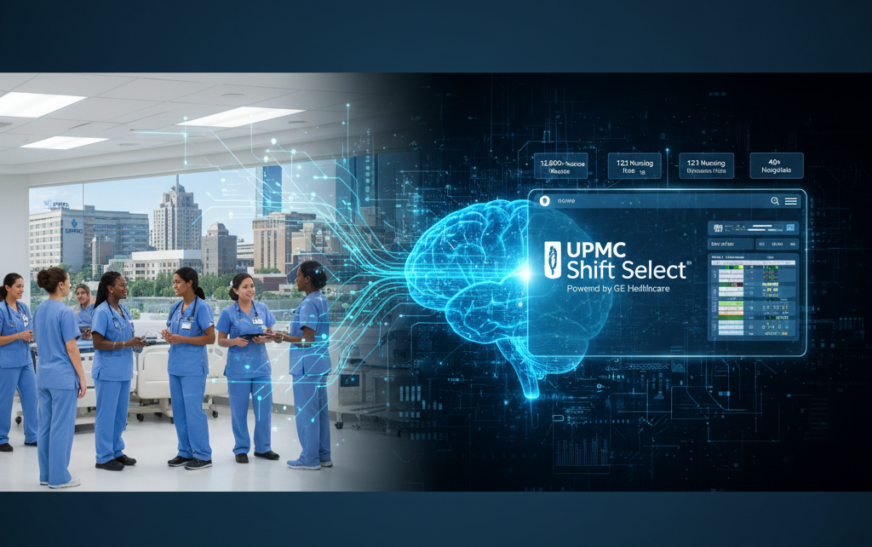
upmc shift select is not a place to buy jeans. It is a healthcare workforce management platform. Specifically, it is the branded implementation of GE Healthcare’s Centricity ShiftSelect Staff Scheduling solution deployed across the University of Pittsburgh Medical Center system .
Think of it as the nervous system of UPMC’s clinical operations. It connects more than 15,000 nurses, 121 nursing units, and countless ancillary staff across a sprawling empire of 40 hospitals, 700 clinical locations, and a 3.8 million-member insurance division. It is not a store. It is a survival tool.
The Identity Crisis of Healthcare Software
The confusion surrounding what Shift Select actually is reveals something important about healthcare technology in 2024. Unlike consumer apps Instagram, Uber, DoorDash enterprise healthcare software lives in the shadows. Nurses use it every single day, often multiple times per shift, yet few could describe it to a family member. It has no Super Bowl commercial. No celebrity endorsement.
But when it breaks? When login fails at 6:45 AM before a twelve-hour shift? The entire hospital feels it.
This invisibility is both a feature and a bug. Good workforce software should disappear into the workflow. But the lack of public understanding creates an information vacuum one quickly filled by outdated forum posts, blog comments from 2019, and the occasional AI-generated article that confuses a scheduling platform with a department store .
So let us set the record straight.
The Pre-Shift Select Era Paper, Excel, and Exhaustion
To understand why Shift Select matters, you must understand what came before.
The Spreadsheet Graveyard
Prior to 2016, UPMC’s scheduling landscape resembled a fractured empire. Some units used sophisticated systems. Others used paper. Many relied on Excel spreadsheets passed between charge nurses like ancient scrolls .
Consider the implications:
- Version control chaos: Three different schedules floating across three different inboxes.
- Bias and favoritism: The nurse who verbally asked first got weekend off. The quiet one worked Christmas.
- Float pool inefficiency: Skilled nurses floating to units where they had no relevant experience.
- Overtime bleed: Last-minute call-outs forcing agency staff at premium rates.
Jill Larkin, DNP, MBA, RN, then senior director of strategic initiatives at UPMC’s Center for Nursing Excellence, summarized it bluntly during a 2017 webinar: “We had some users that were still using paper and Excel spreadsheets … and we also had some technology systems that were outdated.”
The problem was not a lack of effort. It was a lack of integration.
The Hidden Cost: Workforce Morale
In 2016, AMN Healthcare surveyed 85 nurse managers. The findings were sobering:
- 94% said understaffing caused by scheduling issues hurts workforce morale.
- 90% said it makes nurses feel underappreciated.
- Nearly 70% worried about the effect of staffing issues on patient satisfaction .
These numbers are not abstract. They translate to burnout. To nurses leaving the bedside. To the Great Resignation before it had a name.
UPMC recognized that scheduling was never just about filling slots. It was about signaling respect.
The 2016 Go-Live – A Digital Inflection Point
In January 2016, UPMC initiated its first go-live of the Centricity ShiftSelect solution across four flagship hospitals:
- UPMC Presbyterian
- UPMC Shadyside | UPMC Mercy
- Magee-Womens Hospital of UPMC
It was not a modest rollout. Within months, the system was deployed across 121 nursing units and inpatient departments, serving 8,450 employees .
What Did UPMC Actually Want?
The organization articulated three strategic objectives:
- Standardized practices that still accommodated individual unit and staff needs.
- Effective interfaces to improve operational efficiencies.
- Transparency of staffing needs and schedules .
Notice what is missing. Nowhere does the list say “automate everything” or “eliminate human judgment.” The goal was not to replace charge nurses with algorithms. It was to give them better tools so they could focus on what algorithms cannot do: lead, mentor, and triage in real time.
How Shift Select Actually Works
Let us move from strategy to screen. How does Shift Select function in the hands of an actual UPMC employee?
For the Staff Nurse: Autonomy in Your Pocket
For the frontline nurse, Shift Select is liberation.
Finding Shifts:
After logging in via the web portal at upmc.apihc.com or the UPMC mobile application, the nurse navigates to the “Available Shifts” view . Here, open shifts appear with filters for:
- Date and time
- Location (specific hospital or unit)
- Shift type (day, night, weekend)
- Role and required certifications
Found a shift that fits your life? One click on “Select Shift” and it is yours pending any supervisory approvals configured by your unit .
Swapping Shifts:
Imagine Sarah, a UPMC nurse who just discovered her birthday falls on a scheduled shift. In the old system, this meant trading phone calls, hoping a colleague answered, and navigating unit politics.
With Shift Select, Sarah posts her shift to the swap board. Her colleague Mike, certified for the same acuity level, claims it. Sarah enjoys her birthday cake. The unit remains staffed. No manager needed .
This is not convenience. It is retention.
Notifications:
Shift Select offers configurable alerts. New shifts posted? Swap request pending? Schedule change confirmed? The system pushes notifications, ensuring nurses do not miss opportunities or accidentally miss shifts .
For the Charge Nurse: Command Central
The charge nurse role at UPMC has been formally redesigned around these digital tools. The UPMC Center for Continuing Education offers dedicated courses Charge Nurse Essentials: ShiftSelect & TeleTracking explicitly training nurses to “recall TeleTracking and ShiftSelect functions and how these applications are used by the charge nurse” .
What does this look like practically?
A charge nurse opening Shift Select sees:
- Real-time staffing gaps
- Skill mix deficiencies (too many novices, not enough experienced RNs)
- Upcoming off-boards and predicted discharges
- Float pool availability
This is not about filling a grid. It is about preventing the 7:00 PM crisis before it begins.
For the Administrator: The API Layer
Behind the user interface lies the Shift Select API the “secret handshake” that allows authorized administrators to manage users programmatically .
Administrators can:
- Add new users during onboarding
- Modify user status (promotions, role changes, department transfers)
- Deactivate accounts for departed employees
- Manage group assignments and float pool rosters
This is the plumbing. It is unglamorous. It is also why UPMC can onboard thousands of new graduate nurses annually without scheduling chaos.
The Evidence – Does It Actually Work?
UPMC did not implement Shift Select on faith. They measured.
The NDNQI Survey Results
UPMC participates in the National Database of Nursing Quality Indicators (NDNQI) survey, specifically tracking the question: “How much influence do you have over the hours or schedule that you work?”
Comparing 2015 (pre-implementation) to 2016 (post-implementation), the four pilot hospitals saw:
- 2.27% to 6.73% increases in scheduling satisfaction scores.
- All four hospitals ranked above the national mean.
- ShiftSelect-adopting units scored 33% to 62% higher than non-adopting units within the same hospitals .
Lorraine Brock, MSN, RN, then director of workforce management at UPMC, called this “a really great win.” Her caveat is instructive: “For those of you … who work with NDNQI or other similar surveys, you know how difficult it is to increase those numbers especially with an initial rollout to over 4800 users.”
In healthcare workforce measurement, single-percentage-point gains are victories. Six-point gains are tectonic.
The Overtime Story
Critics of self-scheduling often warn of overtime explosion nurses gaming the system, units chronically understaffed, premium pay spiraling.
UPMC observed the opposite.
Comparing percent of overtime against total hours paid (volume-adjusted), all four pilot hospitals experienced reductions between 0.14% and 0.84% .
These numbers appear modest. Multiply them across 15,000 nurses over eight years. The savings cascade into millions.
The Invisible Win: Recruitment
No metric captures this perfectly, but ask any nurse recruiter: scheduling flexibility sells. In a competitive labor market where travel contracts pay premiums and “burnout” is no longer a taboo word, the ability to offer nurses control over their calendars is not a perk it is table stakes.
UPMC’s investment in Shift Select signaled something to the workforce: We see you. We know you have a life. We will not treat you like a shift-filling robot.
Today’s Frontier Mobile, AI, and the Post-Pandemic Workforce
The Mobile Shift
The 2016 implementation assumed desktop access. By 2026, that assumption is obsolete.
Nurses do not want to sit in a breakroom logging into a terminal. They want to grab a shift while waiting for coffee. They want to swap with a colleague from the parking garage.
UPMC has responded. The Shift Select mobile application available for both Android and iOS brings the full scheduling functionality to personal devices . This is not a stripped-down “lite” version. It is the command center, compressed into six square inches of glass.
Implication: The boundary between work and life blurs. But for a generation of nurses who grew up managing everything else on their phones, this is not intrusion. It is expectation.
The Float Pool Reimagined
One of Shift Select’s most quietly revolutionary applications is float pool management .
Traditionally, float nurses were treated as interchangeable bodies sent wherever the spreadsheet demanded, regardless of specialty fit. The result: med-surg nurses floated to ICU feeling terrified; ICU nurses floated to med-surg feeling bored; patients sensed the mismatch.
Shift Select enables skill-based floating. A float nurse logs in, sees open shifts matching their competencies, and self-selects into appropriate environments. The nurse works confidently. The unit receives competent help. The patient receives better care.
This is efficiency with dignity.
The User Experience – Real Questions, Real Answers
Despite its sophistication, Shift Select is not immune to user friction. Analysis of actual employee questions reveals recurring themes :
Q: How do I get access to Shift Select?
A: Access is typically provisioned during onboarding. HR or your supervisor provides login credentials for upmc.apihc.com. If you lack access after starting, contact your unit director or the UPMC IT support line at 412-647-8762 .
Q: Is there a mobile app?
A: Yes. upmc shift select offers dedicated applications for iOS and Android. Search upmc shift select in your device’s app store .
Q: Can I set up notifications?
A: Yes. Within your profile settings, you can configure alerts for new shift postings, swap requests, and schedule changes. This is highly recommended to avoid missing opportunities .
Q: Why was my shift swap not approved?
A: Several possibilities: the colleague you swapped with may lack required certifications for that specific unit; your unit may require managerial approval for all trades; or the swap violated overtime or hours-of-work policies. Check with your supervisor .
Q: Can I view my past schedules?
A: Generally, yes. Shift Select retains historical schedules. This is useful for timesheet verification, professional portfolio documentation, or simply tracking your own patterns .
These questions reveal a system that is powerful but not always intuitive. They also reveal workforce expectations: nurses want transparency, mobility, and control.
Beyond UPMC The Ecosystem of Shift Select
UPMC is the named entity in our keyword, but the software extends far beyond Pittsburgh.
Centricity ShiftSelect the underlying product is deployed across hundreds of healthcare organizations nationally . Yale New Haven Health, Atrium Health, and numerous other systems operate variants of the same platform under different brand names .
This matters for UPMC employees who transfer between health systems. The interface may look slightly different, but the muscle memory transfers. This is intentional. GE Healthcare designed ShiftSelect as an industry standard, not a custom artifact.
The IBM Connection
A fascinating footnote: UPMC’s infrastructure supporting Shift Select runs on IBM FlashSystem storage. Kevin Muha, UPMC’s former Director of Storage and Data Protection, described the migration project as “a ‘lift, shift and forget’ project” .
The pun was presumably intended. “Lift and shift” is cloud migration terminology. But applied to Shift Select, it becomes accidentally poetic: UPMC lifted scheduling out of the paper age, shifted it into the digital present, and forgot in the best possible way that staffing was ever difficult.
Critiques and Cautions No Tool Is Neutral
No honest assessment of workforce technology ignores the downsides.
The Algorithmic Anxiety
Some nurses report discomfort with self-scheduling systems. They feel pressure to constantly monitor shift boards. They worry that colleagues who check obsessively will “game” the system, leaving less desirable shifts for everyone else .
This is a legitimate critique. Self-scheduling requires self-advocacy. For nurses who are less tech-confident, less assertive, or simply too busy to refresh a mobile app hourly, the system can feel exclusionary rather than empowering.
The counterweight: Training and policy. UPMC’s investment in charge nurse education specifically addresses equitable distribution of shifts. The tool is only as fair as the humans configuring it.
The Surveillance Question
Shift Select tracks who works when, who swaps, who cancels, who picks up. This data is invaluable for workforce planning. It is also, potentially, a surveillance apparatus.
Nurses have asked: Is my manager watching how often I request weekend off? Am I penalized subtly for declining shifts?
UPMC has not publicly addressed these concerns. But any health system deploying automated scheduling must transparently communicate how employee data is used, protected, and not weaponized.
The Digital Divide
Shift Select assumes reliable internet access, a charged smartphone, and digital literacy. Most nurses possess these. Not all do.
Seasoned nurses approaching retirement may prefer paper. Night shift nurses working in dead-zone hospital wings may struggle with connectivity. Per diem staff who rarely log in may miss critical communications.
The solution: Redundancy. UPMC maintains backup systems, including HR Direct and Infonet portals, ensuring multiple access pathways . But the friction remains real.
The Future From Shift Selection to Career Architecture
Where does Shift Select go from here?
Prediction One: Integration with Professional Development
Today, Shift Select knows what shifts you work. Tomorrow, it will know what certifications you hold, what skills you seek, and what career trajectory you desire. It will recommend not just shifts, but learning opportunities a critical care course because you’ve expressed interest in ICU; a preceptorship because your clinical hours qualify you to teach.
Prediction Two: Consumer-Grade User Experience
Healthcare software has historically lagged consumer tech by five to seven years. That gap is closing. Expect Shift Select to adopt design patterns familiar from Uber or Airbnb: swipe to claim, star ratings for shifts, personalized recommendations.
Prediction Three: Interoperability Beyond UPMC
As health systems consolidate and care shifts across settings, workforce data must travel. A nurse working at UPMC and a affiliated outpatient surgery center should have unified scheduling visibility. The technology exists. The political and contractual barriers are dissolving.
Conclusion:
The search term upmc shift select will continue to generate queries from new hires, frustrated users, and curious analysts. Some of those queries will land on pages that mistake a scheduling platform for a clothing retailer . Others will find outdated implementation data from 2016.
But the living reality of Shift Select exists in the workflows of 15,000 nurses who start their shifts not with dread about their next day off, but with confidence that their schedules reflect their lives, their preferences, and their value to an organization that chose to invest in their autonomy.
Healthcare’s staffing crisis will not be solved by software alone. But software can remove the unnecessary friction that turns a manageable profession into an unbearable one.