
Imagine typing a single word into Google and being transported to three completely different destinations.
One user searches edusprint hoping to pay their child’s school fees. Another types the exact same keyword looking for a corporate learning management system. A third is a teacher seeking an agile classroom methodology to replace boring lectures. All three use identical spelling. All three are looking for edusprint All three will find something but not necessarily what they expected.
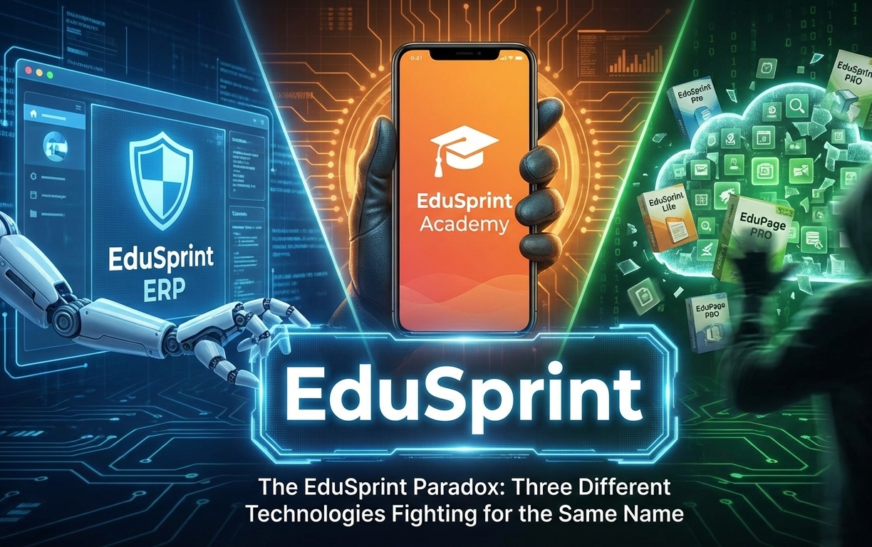
This is the edusprint paradox.
Unlike most technology keywords that point to a single product or company, the term edusprint has fractured into three distinct identities, each serving a different continent, audience, and educational need. One is an Indian school ERP empire serving 125+ institutions. Another is a global Open edX platform with users from Canada to Turkey. The third is a Swiss-designed pedagogical method that transforms classrooms into Scrum teams.
This article is the first to map this fragmented ecosystem. Whether you are a school principal, a corporate trainer, or an innovative classroom teacher, understanding which edusprint you actually need is no longer optional, it is essential.
The School Administration Powerhouse
The 35-Year Overnight Success
In 1990, Mumbai was not yet India’s startup capital. Personal computers were still novelties. Yet Paresh Shantilal Sheth, a commerce and computer applications postgraduate, founded MICM Net Solutions Pvt. Ltd with a vision most considered premature: schools would one day run on software .
Thirty-five years later, MICM’s flagship product edusprint is a cloud-based Enterprise Resource Planning system deployed across over 125 educational institutions in western India, primarily Maharashtra, Gujarat, and Rajasthan . It did not happen overnight. It happened through three decades of patient iteration, on-site training, and an almost obsessive focus on the granular needs of Indian schools.
What edusprint Actually Does
Unlike generic international school management software, edusprint was built specifically for the complexities of the Indian education ecosystem. Its architecture, leveraging .NET 4.7, MVC, and Web API with multi-tenancy cloud support, enables five core functionalities :
1. Financial Operations as a Foundation
At Adani International School, edusprint is positioned not as a general communication tool but specifically as the “trusted online portal that allows families to manage fee and other payments” . The platform provides GST-compliant online shopping carts a first-of-its-kind feature when launched enabling parents to pay fees, view history, download receipts, and complete admission registrations from anywhere .
2. Parent-School Communication Ecosystem
The edusprint mobile application ecosystem is three-pronged:
- edusprint Pro: Parents access academics, activities, attendance, timetable updates, circulars, and photo galleries in one unified interface
- edusprint plus: Real-time alerts and student updates pushed directly to parents
- edusprint Lite: Teacher-facing interface for accessing digital content
3. Visitor Management and Security
The edusprint Scanner application transforms school security. Administrative staff scan QR codes to register visitor entry and exit, maintain complete visit histories, and schedule meetings all through a dedicated mobile interface .
4. Attendance and Identity Integration
Smart Card technology integrates attendance tracking with an online wallet system, allowing students to use a single card for both school entry and cashless payments .
5. Teacher Workflow Optimization
The Lesson Plan Container supports all Indian education and examination boards, saving “huge amounts of teacher’s time” while enabling management to track classroom delivery . The 360-degree staff appraisal and parent feedback systems digitize what was previously paper-based and politically fraught.
The MICM Difference: On-Site, Not Cloud-Only
Most SaaS companies pride themselves on never meeting customers. MICM takes the opposite approach. edusprint provides on-site training for teachers and administrative staff. Parents’ helpdesk services are available on demand. A 35-member technical team deploys account managers and support executives directly to institutions .
Rohan V. Bhat, chairman of Mumbai’s Children’s Academy Group of Schools, summarized the value proposition: “We are satisfied with the ERP software and customer support provided by MICM at competitive cost. This has helped us streamline administration processes and provide quality education at an affordable price” .
This is not Silicon Valley disruption. It is Mumbai persistence.
edSPIRIT – The Global Open edX Challenger
A Different Spelling, A Different Universe
Change one letter. Change everything.
edSPIRIT (with an ‘I’) shares almost no DNA with MICM’s edusprint It is not an ERP system. It does not manage school fees or parent communications. Instead, edSPIRIT is a learning management system built on top of the Open edX platform the same infrastructure used by Harvard, MIT, and Stanford for their massive open online courses .
The Architecture of Open edX
Open edX is not merely software; it is an ecosystem. Developed originally by edX (now part of 2U), the platform powers millions of learners globally. edSPIRIT’s innovation was recognizing that Open edX, while powerful, was technically intimidating for smaller institutions and individual educators.
edSPIRIT’s SaaS plan solves this. Users receive fully managed Open edX instances provisioned in “a few clicks.” No server configuration. No DevOps team. No Python debugging .
Who Actually Uses edSPIRIT?
User reviews, though few, are revealing.
Cecilia L. , a director at a Canadian e-learning company with 51-200 employees, sought a LMS that would let her “manage my own courses as a learning expert, while keeping my own brand.” Her evaluation of multiple providers concluded that edSPIRIT had “the easiest onboarding process and the most teaching and learning, analytics features.” Notably, she emphasized her non-technical background: “I am not a tech person at all, I think the SaaS plan is the solution for others like me” .
Alejandro M. , a self-employed writing and editing professional in Spain, praised the “really easy to use and very intuitive interface” but noted content loading delays across multiple internet connections, a performance critique the vendor promptly offered to troubleshoot .
Feature Set: Beyond Basic LMS
edSPIRIT’s capabilities extend far beyond course delivery. The platform includes :
- Built-in Course Authoring Studio: Visual, drag-and-drop course creation
- E-Commerce Portal: Direct-to-learner monetization, which Cecilia specifically identified as enabling “another revenue channel”
- Gamification: Badges, leaderboards, and progress tracking
- SCORM Compliance: Interoperability with existing content libraries
- Virtual Classroom Integration: Synchronous learning capabilities
- Comprehensive Analytics: Learner progress, assessment results, content engagement
The platform serves universities, academies, and corporate training centers globally, with a geographic footprint spanning North America, Europe, the Middle East, North Africa, Turkey, and Asia .
The Pricing Paradox
edSPIRIT lists a starting price of $0.01 a symbolic figure that effectively signals “contact us for actual pricing” . A free version exists, distinguishing it from competitors that require immediate payment. Yet the absence of transparent pricing may reflect the platform’s positioning: not as a mass-market consumer tool, but as an enterprise solution requiring consultation.
edusprint – The Agile Classroom Revolution
The Swiss Method
The third claimant to the edusprint name comes from neither India nor Silicon Valley, but from Zurich University of the Arts (ZHdK) .
Here, edusprint (lowercase ‘e’, single word) describes a pedagogical method derived from eduScrum, a Dutch-originated framework for applying agile software development principles to education .
Classrooms as Scrum Teams
In conventional teaching, the teacher lectures; students listen; knowledge transfers one direction. In edusprint, this hierarchy collapses.
Unlike eduScrum, which spans entire semesters, edusprint compresses the iteration cycle into a single working day . This makes it viable for workshops, intensive seminars, or situations where prolonged agile transformation is impractical.
The edusprint workflow:
Preparation Phase:
- The Product Owner (teacher) creates the Sprint Backlog learning objectives itemized and estimated for complexity
- Documentation repository (Wiki or similar) established with external resources
- Teacher assembles balanced teams of four, deliberately mixing abilities while avoiding friendship-based cliques
- Introduction session explains agile learning concepts and cultivates enthusiasm
Execution Phase:
5. Stand-up meeting begins the sprint. Teams plan their approach: work individually or collaboratively? On-site or distributed?
6. Sprint execution. Teams work through backlog items, applying theoretical concepts in practical contexts
7. Sprint Review. Equivalent to examination or final presentation. Product Owner compares outcomes against Definition of Done
8. Retrospective. Teams reflect on performance and identify improvement strategies for future sprints
Material Requirements:
- Physical Scrum board (flipchart, whiteboard, Post-it notes) OR
- Digital project management tools (Asana, Trello, Jira)
Why It Matters
edusprint represents something the other two edusprint do not: a technology-optional methodology.
No software to buy.
No internet needed.
It only asks teachers to think differently.
not as experts who talk.
but as guides who build spaces where students learn.
In an era where education technology increasingly means “buy this platform,” edusprint offers radical counter-programming: better pedagogy, not better software.
The Convergence No One Planned
Three Solutions, One Problem
The edusprint / edSPIRIT/ edusprint triad appears chaotic. It is, in fact, remarkably coherent.
All three respond to the same foundational crisis: traditional education infrastructure fails modern stakeholders.
- MICM’s edusprint addresses administrative infrastructure failure. Schools cannot manually process fees, track attendance, or communicate with thousands of parents using paper registers and notice boards.
- edSPIRIT addresses content delivery infrastructure failure. Subject matter experts cannot deploy high-quality online learning without teams of software engineers.
- ZHdK’s edusprint addresses pedagogical infrastructure failure. Students disengage when treated as passive recipients rather than active collaborators.
Each solution attacks a different layer of the education stack. None invalidates the others. A progressive institution could plausibly deploy all three simultaneously.
The Accidental Ecosystem
Consider the hypothetical Global Academy of 2026:
- Morning: Teachers use edusprint methodology to facilitate collaborative problem-solving. Students self-organize around sprint goals. The teacher, as Product Owner, evaluates not memorization but application.
- Afternoon: Students access personalized learning pathways through edSPIRIT’s Open edX platform. Video lectures stream. Interactive assessments provide instant feedback. Analytics dashboards identify struggling learners before they fail.
- Evening: Parents receive push notifications via edusprint Pro. Fee payments process through GST-compliant portals. Attendance records synchronize automatically. The school administrator reviews 360-degree staff feedback collected digitally.
This is not fantasy. The components exist. They simply do not know each other exist.
Choosing Your edusprint – A Decision Framework
If you have searched edusprint and landed here confused, use this guide:
MICM edusprint IF:
- You operate a school in India (particularly Maharashtra, Gujarat, Rajasthan)
- Your primary pain points are fee collection, parent communication, attendance tracking, or admission management
- You need on-site training and local language support
- You prefer all-in-one ERP over best-of-breed integration
- Your institution has 125+ schools already using the system, providing peer reference
You Should Pursue edSPIRIT IF:
- You need to create and sell online courses under your own brand
- You are non-technical but require Open edX capabilities
- Your audience is global and distributed
- You value built-in e-commerce and monetization features
- You need SCORM compliance and virtual classroom integration
edusprint IF:
- You are a teacher or workshop facilitator seeking active learning methodologies
- Your constraints are time and engagement, not software
- You have no budget for new technology purchases
- You want to experiment with agile frameworks before committing to digital tools
- Your students suffer from lecture fatigue
The Future – Fragmentation or Consolidation?
The MICM Trajectory
MICM Net Solutions shows no interest in becoming a global LMS provider. Their 2020 EWIER recognition emphasized India-specific innovations: GST compliance, regional language interfaces, Smart Card wallets . With 125+ institutional clients concentrated in three states, significant domestic expansion remains available before international markets become necessary.
The edSPIRIT Trajectory
edSPIRIT’s destiny ties to Open edX. As the broader Open edX ecosystem evolves with tutor, palm, and edx-platform improvements edSPIRIT inherits them automatically. Their differentiation lies in managed service ease and vertical-specific configuration, not proprietary lock-in.
The edusprint Trajectory
edusprint faces the classic methodology challenge: spread requires passionate teacher-advocates, not sales teams. Its integration into ZHdK’s CAS Facilitating Innovation program suggests continued refinement within European design and innovation education contexts .
The Name Conflict Resolution
Will the three edusprint eventually collide? Surprisingly, probably not.
MICM owns the edusprint trademark in Indian educational administration contexts. edSPIRIT operates in global LMS markets under distinct spelling. edusprint describes a methodology, not a product, protected by prior publication and academic provenance.
Each occupies sufficient orthogonal space that legal conflict appears unnecessary. The greater risk is user confusion a parent seeking fee payment downloads a corporate LMS demo, or a corporate trainer attempting to implement agile sprints using school ERP software.
Conclusion: The Name Is Less Important Than the Need
The edusprint paradox teaches us something important about education technology in 2026.
We have passed the era of monolithic solutions. No single platform, regardless of engineering excellence, can simultaneously optimize school administration, global online learning delivery, and classroom pedagogy. These are distinct problems requiring distinct tools.
The fact that three unrelated organizations independently adopted “Sprint” nomenclature evoking speed, iteration, and forward momentum is not coincidence. It reflects education’s collective impatience with systems designed for the nineteenth century attempting to serve the twenty-first.
For the school leader: edusprint (MICM) will automate your back office and delight your parents. It will not transform your teaching.
For the course creator: edSPIRIT will launch your Open edX academy without developer headaches. It will not manage your attendance registers.
For the classroom teacher: edusprint will energize your students and deepen their learning. It will not process their fee payments.
Choose not the name. Choose the function.
And if you accidentally purchase the wrong one? Take comfort in knowing you are not the first and you will not be the last to discover that in education technology, identical words rarely mean identical things.