
Every garment you have ever worn was held together by seams. Yet most people give those seams almost no thought. That is understandable when seams work well, they are invisible. When they fail, everything falls apart. Understanding nahttypen, the German term for seam types, is fundamental to garment construction, textile engineering, and fashion design at every level. Whether you are a home sewer, a fashion student, or a professional manufacturer, seam knowledge directly affects the quality, durability, and appearance of everything you make. Furthermore, in 2025 and 2026, the story of nahttypen has taken a genuinely thrilling turn. Laser seaming, AI-driven robotic sewing arms, conductive smart seams, and sustainable bonding technologies are reshaping an ancient craft from the inside out. This guide covers everything from the classics to the cutting edge.
What Are nahttypen ?
Definition and Core Purpose
The word nahttypen translates directly from German as “seam types.” In garment construction and textile manufacturing, a seam is the junction where two or more pieces of fabric are joined together. Seams serve multiple functions simultaneously. They provide structural integrity, define a garment’s shape, influence its silhouette, and contribute to its overall finish and longevity.
Different seam types are selected based on the fabric used, the garment’s intended function, the desired aesthetic outcome, and the available production method. A seam used in a lightweight silk blouse differs fundamentally from one used in heavy-duty workwear denim. Choosing the wrong seam type for a given application results in puckering, fraying, discomfort, or premature structural failure.
Historical Origins in Garment Construction
Seams are as old as clothing itself. Archaeological evidence suggests that early humans used bone needles and plant fibres to join animal hides together more than 30,000 years ago. As woven textiles emerged across ancient civilisations, more refined joining techniques followed. The basic principles established over those millennia, aligning fabric edges, joining them securely, and finishing raw edges to prevent fraying, remain relevant today. What has changed dramatically is the precision, speed, and technical sophistication with which those principles are applied.
Traditional nahttypen and Their Everyday Applications
Understanding the foundational nahttypen is essential before exploring modern innovations. Each classic seam type solves a specific problem in garment construction.
The Plain Seam
The plain seam is the most commonly used seam type in garment manufacturing worldwide. Two fabric pieces are placed right sides together, stitched along the seam allowance, and then pressed open or to one side. It is fast, versatile, and appropriate for a wide range of fabrics. However, its raw edges require finishing through serging, zigzag stitching, or binding to prevent fraying over time.
The French Seam
The French seam encloses all raw edges within its own seam, producing a neat, clean finish on both sides of the fabric. It is sewn in two stages: first with wrong sides together, then flipped and sewn again with right sides together. This seam type is ideal for sheer or delicate fabrics such as chiffon and silk organza. Moreover, it adds a premium quality signal to lingerie, bridal wear, and couture garments.
The Flat-Felled Seam
The flat-felled seam is a highly durable, double-stitched seam visible on the outside of the garment. It is the defining structural seam of denim jeans, workwear, and outdoor clothing. Both raw edges are folded under and stitched flat, creating exceptional strength and a characteristic visible topstitch line. As a result, flat-felled seams are chosen wherever garments must withstand repeated stress and heavy laundering.
The Overlock Seam
The overlock seam, also called a serged seam, is produced by an overlock machine that simultaneously trims the seam allowance, encases the raw edge with looped thread, and stitches the seam in a single pass. It produces a clean, stretchy finish that is essential for knitwear, activewear, and jersey garments. Without overlock finishing, knit fabrics would unravel rapidly at every edge.
The Bound Seam
In a bound seam, the raw seam allowance edges are wrapped and enclosed within a strip of binding fabric. This is a standard technique in tailored jackets, unlined coats, and premium sportswear. The binding adds both a clean interior finish and an additional layer of reinforcement at stress points. Additionally, visible contrast binding has become a deliberate design feature in contemporary fashion collections.
The Lapped Seam
The lapped seam overlaps one fabric edge over another and stitches through both layers. It is widely used in leather goods, denim construction, and technical outerwear. Because no seam allowance is pressed open, it creates a flatter profile important in garments where bulk must be minimised for comfort or fit precision.
Why nahttypen Remain Essential in Modern Fashion Design
Despite automation and technological disruption across the textile industry, the fundamental importance of selecting the correct seam type has not diminished. On the contrary, it has grown more nuanced. Modern garments must perform across a wider range of conditions than ever before. Athleisure must transition from gym to street. Workwear must be both professional and physically flexible. Outdoor garments must manage moisture, wind, and temperature simultaneously.
Each of these performance demands places specific requirements on seam construction. A seam that works beautifully in a woven cotton shirt will fail in a high-stretch performance fabric. Similarly, garments intended for medical environments require seam types that can withstand repeated sterilisation cycles. Therefore, designers and manufacturers who deeply understand nahttypen possess a genuine competitive advantage in product development.
Technological Innovations Revolutionising nahttypen
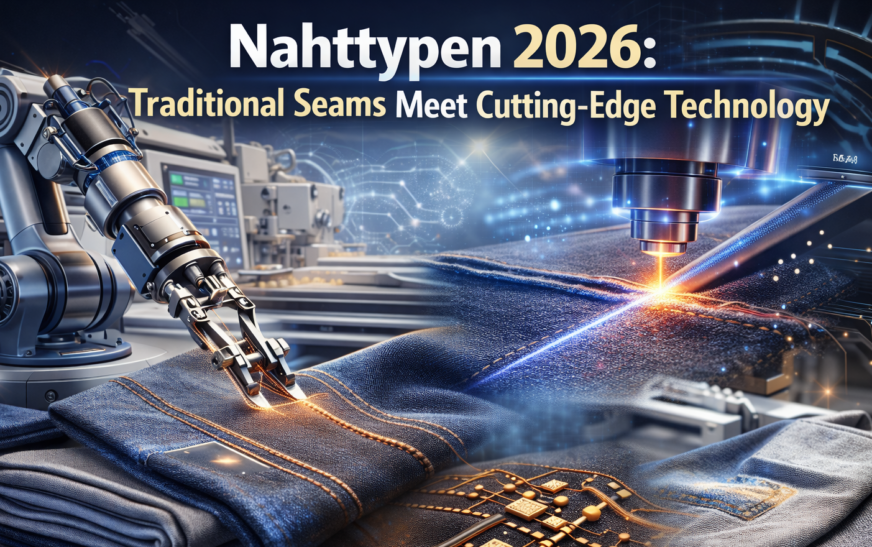
This is where the evolution of seam technology becomes genuinely exciting. The nahttypen of 2025 and 2026 extend far beyond thread and needle; they represent some of the most sophisticated manufacturing engineering currently applied to textiles.
Laser Seaming and Precision Cutting
This eliminates fraying entirely at the cut edge, removing the need for separate edge-finishing steps. Furthermore, laser bonding, where thermoplastic adhesive films are activated by precisely directed laser energy, creates seams that are entirely thread-free. These bonded laser seams are used in high-performance swimwear and cycling apparel, where drag reduction and smooth surface aerodynamics are critical.
Ultrasonic Welding and Bonded Seams
Ultrasonic welding joins synthetic fabrics by applying high-frequency vibration energy that generates localised heat at the fabric interface. The fibres fuse permanently without any thread, adhesive, or moisture. This technique produces waterproof seams that are essential in outdoor membranes, surgical drapes, and protective workwear. In 2025, ultrasonic welding equipment had become significantly more compact and programmable, allowing it to be integrated into semi-automated garment assembly lines that previously required entirely manual seam construction.
AI-Driven Robotic Sewing Arms
Robotic sewing has been a goal of the textile industry for decades. Fabric’s inherent flexibility made automation extremely difficult; unlike rigid materials, fabric shifts, stretches, and behaves unpredictably under mechanical handling. However, AI-powered robotic sewing systems developed by companies such as SoftWear Automation and Sewbo achieved breakthroughs in 2024 and 2025. These systems use real-time computer vision and machine learning to track fabric position continuously and adjust needle placement at speeds and precision levels no human operator can match. As a result, consistently perfect seam alignment is now achievable at an industrial scale, reducing defect rates substantially.
Smart Conductive Seams for Wearable Technology
One of the most transformative developments in nahttypen is the emergence of conductive seams. These seams incorporate electrically conductive threads, typically silver-coated or carbon-fibre-based, into the seam structure itself. The seam, therefore, serves a dual function: structural joining and electrical signal routing. In 2025 and 2026, conductive seams are being used to integrate biometric sensors, LED elements, heating circuits, and motion-capture electrodes directly into garments. Medical monitoring garments from companies such as Myant and Hexoskin now use conductive-seam technology to continuously and comfortably track heart rate, respiratory rate, and muscle activity.
IoT Real-Time Quality Control
The Internet of Things has entered seam manufacturing in a practical and impactful way. IoT-connected sewing machines now transmit operational data, such as stitch tension, feed speed, needle temperature, and thread consumption, in real time to centralised quality management systems. Anomalies are flagged instantly. A seam sewn with incorrect tension is identified before the garment advances to the next production stage. This real-time intervention dramatically reduces the cost of quality failures and minimises material waste from defective production runs.
3D-Printed Seam Reinforcement
Additive manufacturing is now being applied directly to seam construction. 3D-printed thermoplastic reinforcements can be deposited along seam lines, adding targeted structural support at high-stress points such as pocket openings, crotch seams, and shoulder joins. This technique allows engineers to place reinforcement precisely where structural analysis identifies weakness without adding unnecessary weight or bulk across the entire garment.
Benefits of Advanced nahttypen for Manufacturers and Designers
The practical advantages of adopting advanced seam technologies are substantial. Production speed increases when robotic sewing arms and automated seam optimisation software reduce manual handling time. Quality consistency improves when IoT monitoring eliminates human error from seam tension management. Material efficiency increases when laser cutting eliminates fraying and removes the need for wide seam allowances.
For designers, advanced nahttypen open creative possibilities that were previously unavailable. Thread-free bonded seams enable seamless silhouettes in technical fabrics. Conductive seams allow electronics integration without visible external hardware. 3D-printed reinforcements permit structural confidence in experimental fabric combinations that would previously have been too fragile for commercial production.
nahttypen and Sustainability in the Textile Industry
Sustainability is now a central concern in textile manufacturing, and seam technology plays a meaningful role in the industry’s environmental performance. Traditional sewing processes consume thread, water for wet finishing, and significant energy. Waterless bonded seams and ultrasonic welding eliminate both water consumption and the use of chemical adhesives during seam construction. This aligns directly with the industry’s broader push toward waterless production methods.
Additionally, AI-driven seam optimisation software minimises fabric waste during pattern placement and seam allowance calculation. When seams are constructed more efficiently, less fabric is consumed per garment. Over millions of production units annually, that reduction adds up to genuinely significant environmental savings. Furthermore, seams that perform longer under stress reduce garment replacement frequency, extending product life cycles and reducing overall textile waste.
Future Trends and the Evolution of Seam Technology
Several developments on the immediate horizon will further transform nahttypen over the next few years. Self-healing seam materials, fabrics, and bonding agents that can repair microscopic damage autonomously when exposed to heat or moisture are currently in advanced research stages at multiple textile engineering institutions. Commercial applications are anticipated within three to five years.
Fully automated, AI-directed garment assembly lines where robotic arms handle the entire construction sequence from cut panel to finished garment without human intervention are moving from prototype to pilot production in several major manufacturing hubs. When these systems reach full commercial scale, the economics of garment manufacturing will shift dramatically. Finally, digital seam simulation tools are improving rapidly, allowing designers to test seam performance virtually across hundreds of stress scenarios before a single physical sample is cut.
Conclusion: The Seam Is No Longer Simple
The humble seam has always been the invisible backbone of clothing. Understanding nahttypen from the classic French seam to the AI-optimised robotic stitch gives designers, manufacturers, and consumers a sharper appreciation of how garments are truly made. Traditional seam types remain essential and continue to serve critical functions across every category of clothing. At the same time, the technological innovations of 2025 and 2026 are expanding the definition of what a seam can be and do.
Seams can now conduct electricity, monitor health, resist water without chemical treatment, and reinforce themselves in three dimensions. They can be sewn by robots, monitored by algorithms, and validated in real time by IoT systems. The future of nahttypen is not a replacement of craftsmanship, it is an elevation of it. Whether you are refining your sewing practice or specifying materials for industrial production, deepening your knowledge of seam types will always reward you. Explore the latest seam technologies, experiment with advanced construction methods, and stay curious about what comes next.