
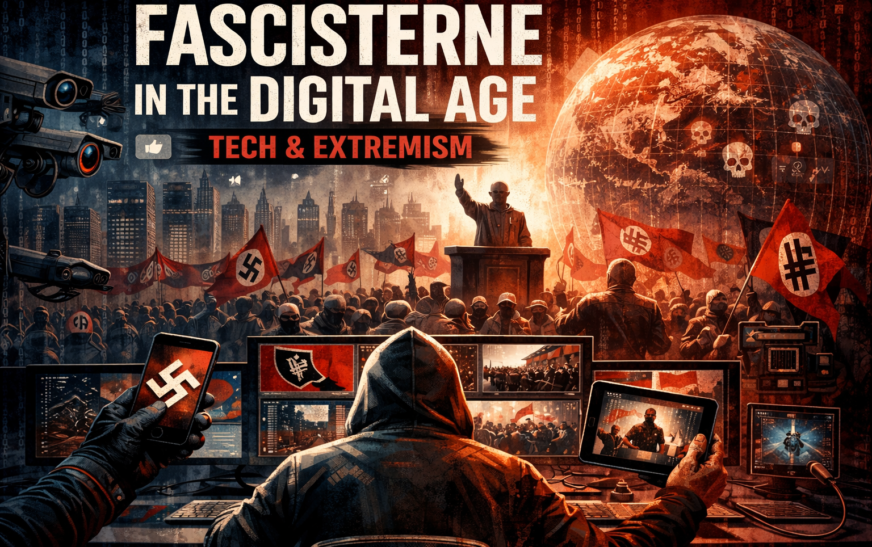
A single word carries enormous weight in Danish political discourse: fascisterne, literally “the fascists.” Used both as a historical label and a sharp contemporary accusation, the term cuts through ideological debate with unmistakable force. For decades, it evoked images of black-uniformed movements, mass rallies, and state terror. Today, however, fascisterne operates in a far more complex environment. Algorithms, deepfakes, and surveillance systems have given old authoritarian impulses new and powerful tools. Understanding this intersection is essential for anyone trying to navigate modern politics with clear eyes.
Historical Foundations of Fascisterne
Fascism emerged in Europe after World War I as a response to economic collapse, wounded national pride, and deep fear of communist revolution. Benito Mussolini founded the first fascist movement in Italy in 1919. Adolf Hitler’s National Socialism in Germany followed a parallel path, combining ultranationalism with racial ideology and single-party dictatorship.
In Denmark, fascisterne had their own chapter. The Danmarks Nationalsocialistiske Arbejderparti (DNSAP) attracted members throughout the 1930s and reached peak influence during the German occupation from 1940 to 1945. After liberation, most Danish collaborators faced legal punishment, and organised fascism lost its political footing. Nevertheless, the ideas did not disappear entirely; they went underground, splintered, and eventually re-emerged in new forms.
Historians widely agree that classical fascism shared several defining traits: a cult of the strong leader, contempt for liberal democracy, extreme nationalism, scapegoating of minority groups, and glorification of violence as a political tool. These foundations remain relevant today because modern extremist movements draw directly from them, often consciously.
Core Ideology and Characteristics
The Cult of the Leader and Anti-Democracy
Fascist movements consistently elevate a charismatic, infallible leader above democratic institutions. Elections are framed as rigged or irrelevant. Courts and parliaments are portrayed as obstacles to national will. In the digital era, this same narrative spreads through YouTube channels, encrypted messaging groups, and podcasts that reach millions of listeners without editorial oversight.
Ultranationalism and Scapegoating
A fierce “us versus them” dynamic drives fascist rhetoric. Minority groups, whether defined by ethnicity, religion, or sexual orientation, are blamed for societal problems. Scapegoating is psychologically effective because it offers simple answers to complex crises. Digital platforms amplify this tendency. Recommendation algorithms on social media platforms often surface outrage-generating content, leading to nationalist and xenophobic posts spreading faster than moderate or corrective content.
Violence as Virtue
Classical fascism celebrated violence openly. Modern tech-enabled extremism does so more indirectly, through coded language, memes, and irony that provide plausible deniability. Researchers at organisations like the Global Network on Extremism and Technology (GNET) have documented how online communities in the 2020s normalised calls for political violence through layers of humour and abstraction.
Fascisterne in the Digital Age: Recent Technologies at Play
Artificial Intelligence and Automated Propaganda
By 2025 and into 2026, large language models had become powerful enough to generate persuasive political text at an industrial scale. Extremist groups quickly recognised this potential. AI tools can produce thousands of individualised propaganda messages per hour, each tailored to specific psychological profiles derived from social media data. Furthermore, AI-generated audio and video, commonly known as deepfakes, allow the fabrication of speeches, confessions, or inflammatory statements attributed to real politicians and journalists.
In 2024, deepfake videos of European and American politicians were detected circulating on Telegram before major elections. The production quality was high enough to fool a significant minority of viewers, even after fact-checkers issued corrections. Consequently, public trust in authentic video evidence has begun to erode a dynamic that authoritarian-leaning movements actively exploit by dismissing real footage as fabricated.
Social Media Radicalisation Pipelines
Social media platforms function as radicalisation pipelines in ways their designers arguably did not intend, though critics argue the financial incentives for engagement made such outcomes predictable. A user who watches one nationalist video is algorithmically served more extreme content in an accelerating sequence. Researchers at Stanford Internet Observatory and the Oxford Internet Institute have mapped these pathways in detail, showing that radicalisation from mainstream political content to explicitly fascist ideology can occur within weeks of sustained platform use.
Moreover, private groups on platforms like Facebook, Telegram, and Discord allow fascisterne adjacent communities to organise away from public scrutiny. End-to-end encryption, originally designed to protect privacy, also shields violent planning from law enforcement detection. This presents a genuine ethical dilemma: limiting encryption would harm human rights defenders worldwide, yet leaving it unrestricted would provide cover for extremist coordination.
Surveillance Technology and Digital Authoritarianism
On the other hand, states themselves increasingly deploy surveillance technologies in ways that concern civil liberties organisations. Facial recognition systems, predictive policing algorithms, and mass data collection programs share technical DNA with the surveillance apparatuses that historical fascisterne used to identify and persecute opponents. China’s social credit system and the use of facial recognition against Uyghur communities represent contemporary examples where technology enables population control at a scale that mid-twentieth-century authoritarian regimes could only dream of.
In addition, authoritarian-leaning governments in Hungary, Turkey, and Brazil during the early 2020s used lawfare combined with digital surveillance to target journalists, political opponents, and NGOs. These cases blur the line between elected governments with fascist tendencies and classic one-party fascist dictatorships, raising urgent definitional and strategic questions for democratic institutions.
Data-Driven Targeting and Micro-Propaganda
Cambridge Analytica’s methods, exposed in 2018, became a prototype for politically motivated data weaponisation. By 2026, more sophisticated successors were using real-time behavioural data to deliver micro-targeted political messaging. Extremist networks purchase or steal user data to identify psychologically vulnerable individuals those expressing economic anxiety, social isolation, or grievance and then direct carefully crafted recruitment content toward them. This is not speculation; law enforcement agencies in Germany, the UK, and the United States have documented such pipelines in terrorism prosecution files.
Modern Case Studies and Global Implications
Germany’s Federal Office for the Protection of the Constitution (Verfassungsschutz) reported in 2024 that far-right extremist groups in Germany had substantially increased their use of AI-generated content for recruitment. The AfD’s more radical fringes, while legally distinct from neo-Nazi organisations, share online spaces and messaging strategies with openly fascist groups. In Italy, debates continue about whether the governing Fratelli d’Italia party represents a continuation of fascist political culture or a genuine democratic evolution, a question that political scientists answer very differently depending on their methodological frameworks.
In Denmark itself, fascisterne today appear less in organised parties and more in diffuse online communities. The Stram Kurs party, led by Rasmus Paludan until his political decline, and successor fringe movements combine ethnonationalist rhetoric with social media savvy. These groups are small but skilled at generating disproportionate media attention.
Globally, the pattern is consistent: tech-enabled extremism does not require large membership rolls to cause significant harm. A handful of networked individuals with AI tools, encrypted channels, and social media accounts can generate the visibility and psychological impact that once required mass movements.
Challenges, Countermeasures, and Future Outlook
Platform Governance and Content Moderation
Social media platforms have expanded content moderation teams and AI-driven flagging systems. However, these systems struggle with context, language diversity, and the constant evolution of extremist coded language. Terms and symbols are deliberately obscured, a strategy researchers call “semantic evasion.” Platforms must continuously update classifiers, while extremist communities adapt faster than moderation systems can keep up.
Legislative Responses
The European Union’s Digital Services Act (DSA), fully implemented by 2024, introduced stronger requirements for large platforms to assess and reduce systemic risks, including the amplification of harmful content. Germany’s Network Enforcement Act (NetzDG) mandated faster takedowns of illegal content. These measures are steps forward, but enforcement remains inconsistent across borders, and platforms operating outside EU jurisdiction face fewer constraints.
Education and Media Literacy
Perhaps the most sustainable countermeasure is widespread media literacy education. Several Nordic countries, particularly Finland, have integrated digital and media literacy into school curricula at all levels. Research published in 2025 showed that students trained to identify propaganda techniques, including AI-generated content, were significantly less susceptible to radicalisation messaging. Furthermore, prebunking strategies (inoculating audiences against specific manipulation techniques before exposure) have shown promising results in randomised controlled trials.
The Ethical Horizon
As AI systems become more capable, the gap between authentic and fabricated reality will narrow further. This creates a crisis for democratic epistemology shared factual ground, the basis of democratic deliberation, is eroding. Addressing this requires coordinated action across government, technology, civil society, and education. No single actor can close this gap alone.
Conclusion
Fascisterne, as both a historical phenomenon and a living political concept, demands serious and sustained attention in 2026. The ideological DNA of fascism, authoritarianism, scapegoating, and contempt for democratic norms has not changed. What has changed is the technical substrate on which it operates. AI-generated propaganda, algorithmic radicalisation, surveillance capitalism, and deepfake technology have given these old ideas new reach, new speed, and new power.
Understanding this intersection is not an exercise in alarmism. It is a prerequisite for effective democratic self-defence. Open societies that fail to grapple with digital authoritarianism, whether it comes from fringe movements or from elected governments, eroding norms, risk sleepwalking into conditions that future generations may recognise, with the benefit of hindsight, as all too familiar. History offers the warning. Technology presents the challenge. The response, as always, depends on the choices citizens, institutions, and platforms make starting now.