

When planning a home renovation or designing a new build, the ceiling often becomes the “fifth wall” , an overlooked canvas with immense potential. Two elegant options that consistently top the list for adding sophistication and architectural depth are coffered and tray ceilings. However, choosing between them can be a design dilemma. This comprehensive guide will illuminate the distinct characteristics, ideal applications, and design impacts of each, transforming your ceiling from an afterthought into the masterpiece of your room.
Understanding the Core Concepts: Definitions First
Before we dive into comparisons, let’s clearly define each style. Grasping their fundamental structures is key to understanding their visual and spatial effects.
What is a Coffered Ceiling?
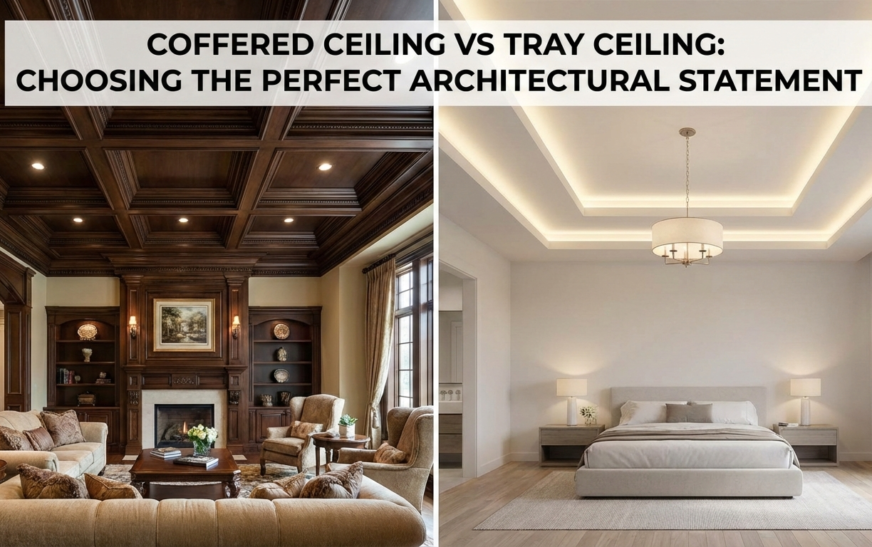
Imagine a ceiling crafted from a grid of sunken, recessed panels. Each panel, called a “coffer,” is framed by beams that intersect, typically at right angles, creating a pattern of indentations. Historically, this design dates back to ancient Greek and Roman architecture, often seen in stone, but today it’s recreated with wood, plaster, or lightweight polyurethane. The result is a dramatic, three-dimensional look that adds a powerful sense of structure, tradition, and grandeur.
What is a Tray Ceiling?
Now, picture a ceiling where the central portion is raised or recessed several inches to a foot higher than the perimeter, resembling an inverted tray. This creates a layered, step-up effect around the edges. Tray ceilings (also known as inverted or recessed ceilings) offer a more modern and streamlined approach to adding volume. They draw the eye upward, emphasize the center of the room, and provide a perfect ledge for innovative lighting or paint treatments.
Head-to-Head Comparison: Breaking Down the Differences
To make an informed decision, let’s examine how these coffered ceiling vs tray ceiling compare across several critical dimensions.
Visual Impact & Style
Coffered ceilings command attention with their intricate, geometric patterning. They introduce a classic, formal, and often luxurious feel—think libraries, studies, and formal dining rooms. The play of light and shadow across the beams and recesses creates dynamic visual interest throughout the day.
Conversely, tray ceilings offer a more contemporary and subtle form of drama. Their clean lines and smooth elevation create a feeling of openness and airiness. They are exceptionally versatile, complementing both modern minimalist interiors and transitional spaces that blend traditional and contemporary elements.
Spatial Perception & Room Suitability
Here, ceiling height is a crucial factor. Generally speaking, coffered ceilings work best in rooms with high ceilings (9 feet or more), as the descending beams can lower the perceived height. In a room with standard 8-foot ceilings, they can feel overwhelming.
On the other hand, tray ceilings are a brilliant solution for rooms with standard ceiling heights. By raising the central portion, they visually increase the volume of the space, making it feel larger and more open. They are exceptionally popular in master bedrooms, living rooms, and dining areas where a sense of spacious serenity is desired.
Complexity & Cost of Installation
This is a practical consideration that significantly affects the decision. Without a doubt, coffered ceilings are the more complex and costly option. They involve precise carpentry, potentially significant structural planning, and more labor-intensive finishing. While lightweight modern materials have made them more accessible, they remain a premium feature.
In contrast, tray ceilings are typically less complex to construct. They often involve building down the perimeter of the room rather than raising the center, which can be simpler from a framing perspective. Consequently, they are usually more budget-friendly while still delivering a high-impact result.
Lighting & Design Integration
Both ceilings offer fantastic opportunities for creative lighting, but in different ways.
Coffered ceilings allow for lighting to be integrated within the coffers (as downlights) or along the beams (as accent lighting). A chandelier can be centered in one large coffer for a magnificent focal point.
Meanwhile, tray ceilings create a natural “shelf” at the step. This is an ideal spot to install concealed LED strip lighting, which washes the upper wall with a soft, ambient glow—a technique known as coving. A pendant or chandelier can then hang from the elevated center, reinforcing the layered effect.
Making Your Choice: A Practical Decision Guide
So, which ceiling is right for your project? Use this final analysis as your roadmap.
Choose a Coffered Ceiling If…
- Your room has high ceilings (9ft+).
- You desire a classic, formal, or traditionally elegant aesthetic.
- The architectural style of your home is Colonial, Traditional, or Mediterranean.
- The room’s purpose is formal, like a dining room, office, or great room.
- Your project budget allows for a significant architectural investment.
Choose a Tray Ceiling If…
- You are working with standard 8-foot ceilings and want to create a sense of height.
- You prefer a modern, transitional, or subtly contemporary look.
- You want to define a space (like a sleeping area in a master suite) without using physical dividers.
- You seek a dramatic effect with a relatively simpler and more cost-effective installation.
- Innovative, indirect lighting is a key part of your design vision.
The Unspoken Third Option: Harmonious Combination
Interestingly, the design world thrives on hybridization. For a truly unique approach, consider combining elements of both. A shallow tray ceiling can be fitted with a grid of faux beams to create a coffered effect within the tray. This merges the height-enhancing quality of the tray with the detailed texture of coffered ceiling vs tray ceiling, perfect for creating a one-of-a-kind statement.
Final Thoughts: Elevate Your Space with Intention
In the debate between coffered ceiling vs tray ceiling, there is no universal winner the perfect choice for your specific space, style, and aspirations. Ultimately, a coffered ceiling is architectural jewelry, adding ornate structure and timeless gravitas. A tray ceiling is architectural sculpture, creating fluid volume and modern elegance.
By understanding their distinct voices, you can move beyond seeing the ceiling as mere overhead space. Instead, you can confidently select the design that will rise to meet your vision, crafting a room that feels complete, intentional, and beautifully elevated from every angle.