
Analytics gave businesses a window into the past. For years, that window felt powerful enough. Teams built dashboards, tracked KPIs, and celebrated when the numbers looked good. However, something important was missing. The data told you what happened. It rarely told you what to do next.
That gap is the defining challenge of 2026. Organizations no longer lack data. In fact, they drown in it. The real problem, therefore, is turning that data into confident, timely action. Analytics alone cannot solve this. Consequently, businesses now need something broader, deeper, and more connected to their actual operations.
1. The Limits of Traditional Analytics
What Analytics Gets Right
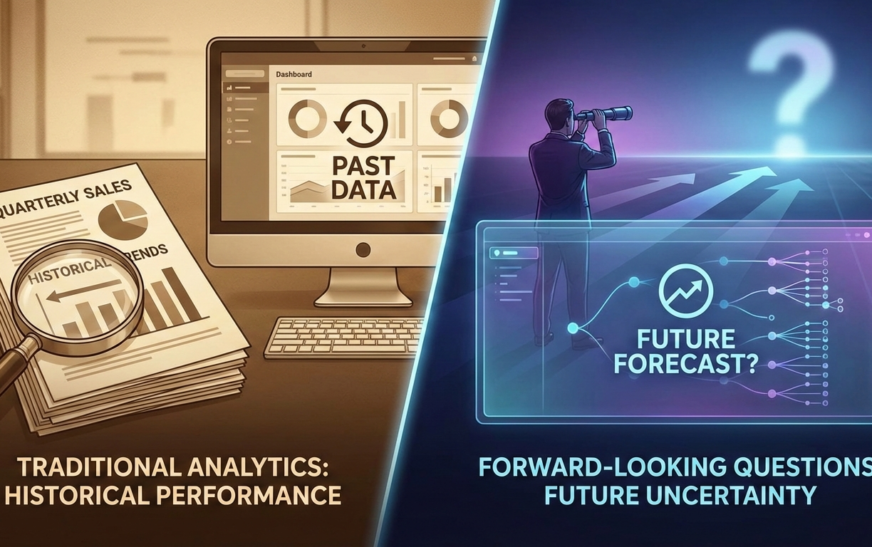
Traditional analytics tools earn their place in every organization. They aggregate data from multiple sources and visualize trends clearly. Moreover, they help leadership understand historical performance at a glance. For routine reporting, these tools deliver solid, reliable value.
Standard analytics platforms excel at answering backward-looking questions. For example, how many units did we sell last quarter? Which region underperformed? As a result, teams stay aligned and accountable when they get accurate answers quickly. Nevertheless, the picture changes when businesses start asking forward-looking questions.
Where Analytics Falls Short
Analytics struggles to answer future-focused questions. What will happen next week? Which customer will churn before they show intent? Where should we invest resources to prevent a bottleneck three months from now? These questions, in contrast, demand a fundamentally different kind of tool.
Static dashboards also demand constant human interpretation. A manager stares at a chart and forms a judgment. That judgment, however, reflects their experience, biases, and available time. Two managers reading the same dashboard often reach different conclusions. This inconsistency, consequently, costs organizations money, speed, and competitive edge.
Another limitation hits hard in fast-moving markets: lag. Most analytics pipelines run on batch data. As a result, insights arrive hours or days after the events that generated them. In industries where conditions shift by the hour, yesterday’s dashboard drives tomorrow’s wrong decision. Therefore, speed of insight has become just as important as accuracy of insight.
2. Beyond Analytics: What Intelligent Business Looks Like
Moving beyond analytics does not mean abandoning data. Rather, it means expanding what organizations do with it. The next tier of business intelligence combines real-time data, predictive modeling, automation, and contextual decision support into a unified operating environment.
Real-Time Intelligence
Leading organizations now process data as it arrives. Streaming analytics pipelines replace overnight batch jobs, and events trigger responses within seconds rather than days. For instance, a customer browses without converting and the system immediately flags this, then routes a personalized offer in real time. Similarly, a machine reading spikes beyond its normal threshold and maintenance receives an alert before breakdown occurs.
Real-time intelligence, therefore, transforms reactive businesses into proactive ones. Teams stop chasing problems and start preventing them. This shift alone produces measurable improvements in customer retention, operational uptime, and revenue capture. In short, speed of response becomes a core competitive advantage.
Predictive and Prescriptive Layers
Predictive models take historical patterns and project them forward. This moves organizations from describing what happened to anticipating what comes next. Prescriptive intelligence, furthermore, goes one step further. Rather than simply forecasting a problem, it recommends the specific action most likely to resolve it.
Consider a supply chain team facing a potential stock-out. A predictive layer raises the alert 10 days in advance. Subsequently, the prescriptive layer identifies the three fastest suppliers, compares current lead times and costs, and surfaces a recommended purchase order. The team reviews and approves in minutes. Previously, that process required days of manual analysis.
Contextual Decision Support
Raw numbers rarely contain enough context to drive confident decisions on their own. Contextual decision support, however, layers meaning onto data. It connects a revenue dip to a concurrent product issue, a staffing gap, and a competitor promotion happening simultaneously. As a result, decision-makers see the full picture rather than just the metric.
Natural language interfaces make this accessible to every level of an organization. Specifically, a non-technical regional manager asks the platform a direct question in plain English. The system then pulls relevant data, applies context, and delivers a clear, reasoned response. No SQL. No BI analyst dependency. Just fast, informed decision-making at every level.
Why the Combination Matters
These three layers real-time intelligence, predictive models, and contextual support work together rather than in isolation. Real-time data feeds the predictive models. The predictive models, in turn, inform the contextual layer. Ultimately, organizations that combine all three gain a decision-making capability that far exceeds anything analytics alone can offer.
3. The Technology Trends Driving This Shift in 2025
Several converging technology trends make the move beyond analytics both possible and urgent right now. Moreover, these trends reinforce each other in ways that compound their individual impact.
Generative AI in Business Operations
Generative AI moved from experimental to operational during 2024 and 2025. Enterprise platforms now embed it directly into their data environments. Consequently, users query complex datasets through conversational interfaces. Reports generate automatically from live data streams, and summaries, forecasts, and recommendations appear without analyst intervention.
This capability, furthermore, democratizes insight across the organization. Junior analysts and frontline managers access the same analytical depth that previously required senior data science teams. As a result, decisions accelerate across every layer of the business rather than bottlenecking at the top.
Unified Data Platforms
Fragmented data infrastructure has long been the biggest enemy of effective analytics. Different teams maintain different systems. Customer data lives in the CRM, while operational data stays in the ERP. Financial data, meanwhile, hides in spreadsheets. Connecting these sources for a single coherent view once took months of engineering work.
Modern unified data platforms, however, collapse this complexity. A single layer ingests, normalizes, and connects data from every source in real time. Teams therefore stop arguing about whose numbers are correct. One source of truth ultimately powers every decision across the organization.
Agentic AI and Autonomous Action
Agentic AI systems represent the most significant leap beyond traditional analytics. Unlike standard tools, these systems do not just surface insights. Instead, they act on them. An agentic workflow monitors campaign performance, identifies an underperforming ad set, pauses it, and reallocates budget to the top performer all without human instruction.
Human oversight, nevertheless, remains essential for strategic and high-stakes decisions. Routine, rule-based responses run automatically. This, in turn, frees teams to focus on creative, strategic, and relationship-driven work where human judgment adds the most value.
4. Industry Examples: not just analytics in Practice
Retail and E-Commerce
Retail teams use predictive intelligence to manage inventory before stockouts occur. Additionally, personalization engines analyze browsing behavior, purchase history, and real-time intent signals to surface relevant products at the right moment. Abandoned cart workflows trigger automatically with personalized incentives. As a result, revenue rises without adding headcount.
Healthcare Operations
Hospitals move beyond patient volume dashboards to predictive capacity planning. Specifically, the system forecasts admission surges 72 hours ahead, and staff scheduling adjusts accordingly. Readmission risk models, furthermore, flag high-risk patients before discharge. Care teams therefore intervene earlier, outcomes improve, and costly readmissions drop significantly.
Financial Services
Banks and investment firms combine real-time transaction data with behavioral analytics and external market signals. Fraud detection models, for instance, act within milliseconds. Portfolio risk alerts surface before exposure breaches thresholds. Moreover, customer lifetime value models guide which clients receive proactive advisory outreach at exactly the right time.
Manufacturing and Supply Chain
Manufacturers embed sensor data from the factory floor into predictive maintenance models. Consequently, equipment failure prediction accuracy reaches levels that manual inspection cannot match. Supply chain platforms, in addition, monitor vendor lead times, geopolitical risk signals, and shipping delays simultaneously. Procurement teams thus receive recommended alternative sourcing options before disruption ever arrives.
5. How to Build a Strategy That Goes Beyond Analytics
Organizations ready to move beyond traditional analytics need a structured approach. Jumping straight to complex AI tools without solid foundations, however, leads to expensive failures. A phased strategy, therefore, delivers far more sustainable results.
Step 1: Unify Your Data Foundation
No intelligent layer performs well on top of fragmented, inconsistent data. Start by auditing all data sources across the organization. Then identify the most critical datasets for decision-making. Build a unified data layer that connects these sources with clean, consistent definitions. This foundation work, ultimately, pays dividends across every initiative that follows.
Step 2: Define Decisions, Not Dashboards
Most analytics projects fail because teams build dashboards without specifying which decisions those dashboards should improve. Instead, flip this approach entirely. Start with the decisions your organization makes most frequently and with the highest stakes. Then design the data and intelligence layer to support exactly those decisions. This shift in framing, consequently, changes everything about how your tools get built and used.
Step 3: Layer Intelligence Gradually
Begin with real-time reporting to replace lagging batch processes. Subsequently, add predictive models for the highest-value use cases first: churn prevention, demand forecasting, or fraud detection. Introduce prescriptive recommendations once the predictive layer proves reliable. Each layer, in turn, builds trust and organizational capability before the next one arrives.
Step 4: Embed Insights into Workflows
Insights only create value when they reach the right people at the right moment. Therefore, embed intelligence directly into the tools teams already use. Surface recommendations inside the CRM when a sales rep opens a customer record. Similarly, trigger alerts within the project management system when a deadline risk appears. Ultimately, removing the step between insight and action is where the real performance gains live.
Frequently Asked Questions (FAQs)
Q: What does not just analytics mean for a small business?
A: For small businesses, it means moving beyond simple monthly reports and spreadsheets. Specifically, start by connecting your sales, marketing, and customer data into one place. Use tools that flag risks and opportunities automatically rather than waiting for someone to notice them. Even basic predictive alerts for example, which customers are likely to churn can have an outsized impact on a small team’s efficiency and revenue.
Q: Is real-time analytics necessary for every business?
A: Not every business needs second-by-second data. The right data speed, however, depends on your industry and the decisions you make most often. A retail brand running live promotions benefits enormously from real-time signals. A professional services firm reviewing monthly client health scores, in contrast, may not. Therefore, identify your most time-sensitive decisions first, then build real-time capability around those specific use cases before scaling further.
Q: How is predictive analytics different from traditional analytics?
A: Traditional analytics describes what already happened. Predictive analytics, on the other hand, uses statistical models and machine learning to forecast what is likely to happen next. For example, where a standard dashboard shows last month’s churn rate, a predictive model identifies which specific customers are most likely to churn this month before they actually leave. This forward-looking view, consequently, enables prevention rather than reaction.
Q: What risks come with moving beyond traditional analytics?
A: The most common risks are data quality issues, over-reliance on model outputs without human review, and organizational resistance to change. Nevertheless, these risks are manageable. Mitigate them by starting with a strong data foundation, keeping humans in the loop for high-stakes decisions, and communicating clearly about why the shift adds value to every team it affects. In short, preparation reduces most of the risk significantly.
Q: Which tools support intelligence beyond traditional analytics?
A: Several strong platforms operate in this space. Databricks, Snowflake, and Google BigQuery, for instance, handle unified data infrastructure at scale. Power BI, Tableau, and Looker provide visualization layers with growing AI features. Furthermore, platforms like Salesforce Einstein, HubSpot AI, and workflow intelligence tools like MiFlow embed predictive and prescriptive intelligence directly into the operational systems where teams actually work every day.
Q: How long does it take to move beyond a traditional analytics setup?
A: Timelines vary based on data maturity and organizational complexity. A focused team with clean, connected data can deploy real-time reporting and initial predictive models within two to three months. A large enterprise migrating from fragmented legacy systems, however, may invest six to twelve months in foundational data work before adding intelligence layers. Starting with a clear use-case roadmap, therefore, shortens the timeline considerably for organizations at any stage.
Conclusion: The Future Belongs to Action, Not Just Analysis
Analytics built the foundation. Every organization that invested in data infrastructure over the past decade gained real advantages. Now, however, the advantage shifts decisively to those who go further.
The businesses winning in 2026 do not just measure performance. Rather, they predict it, shape it, and act on it faster than their competitors can react. Real-time intelligence, predictive models, prescriptive recommendations, and agentic automation form the new operational standard. In short, this is not just analytics This is intelligent business at its highest level.
The transition does not require a perfect starting point. It requires, instead, clarity on which decisions matter most, a commitment to data quality, and a willingness to embed intelligence into daily workflows. Organizations that take these steps today, furthermore, build a compounding advantage that grows harder to close over time.
Data will always matter. Nevertheless, data alone no longer differentiates. What separates leading organizations is their ability to convert information into confident, fast, and accurate action. That, ultimately, is the standard every ambitious business must now meet.