
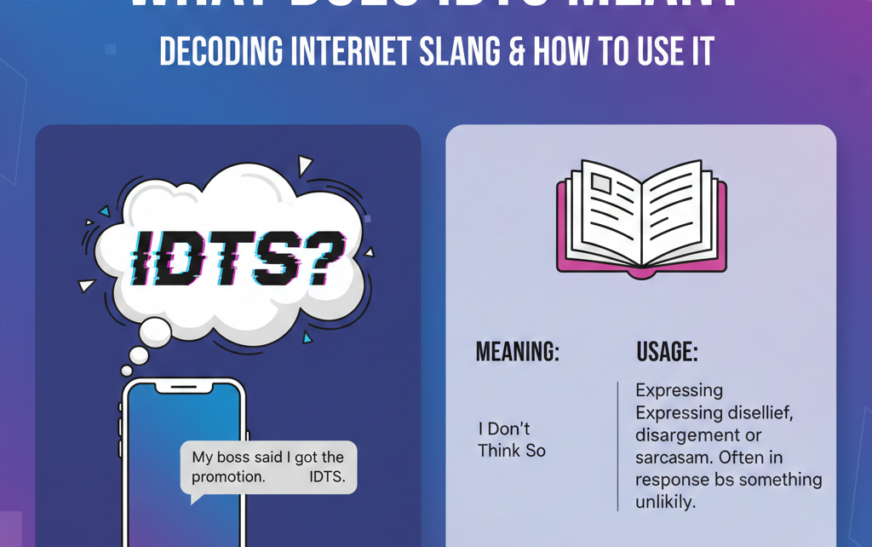
The Lexicon of the Digital Age
In the ever-evolving landscape of digital communication, a new vernacular has emerged. Acronyms and abbreviations fly across screens, forming a shorthand dialect that is both efficient and, to the uninitiated, utterly cryptic. Among the constellation of terms like LOL, BRB, and IMO, one particular acronym has cemented its place in the lexicon of texters, tweeters, and online forum dwellers alike: IDTS.
At first glance, these four letters might seem like random keystrokes. Yet, they carry a specific, nuanced meaning that has facilitated millions of digital conversations. This article will unravel the mystery of what does idts mean, exploring its definition, origins, appropriate usage, and its role within the broader context of internet linguistics and digital culture. By understanding terms like IDTS, we gain insight into how language adapts to the constraints and creativity of new technologies.
What Does IDTS Mean? Breaking Down the Acronym
Let’s begin with the fundamental question: What does IDTS stand for?
IDTS is an acronym for “I Don’t Think So.”
It is a phrase of negation, skepticism, or polite disagreement used primarily in informal digital communication. It occupies a middle ground between a blunt “no” and a more verbose expression of doubt.
The Linguistic Function of IDTS
Linguistically, IDTS serves several key functions:
- Efficiency: It conveys a complete sentence of five syllables (“I don’t think so”) with just four characters, aligning perfectly with the speed-driven nature of texting and messaging.
- Tone Modulation: Unlike a stark “NO,” IDTS often softens the disagreement. It implies the speaker is considering the proposition but ultimately leans against it. It can range from playful sarcasm to genuine, mild skepticism.
- Affiliation: Using recognized internet slang like IDTS signals membership in a digital community. It shows familiarity with the shared language of online interaction.
The Origins and Evolution of IDTS
The exact birthplace of IDTS is difficult to pinpoint, as is the case with most internet slang. Its evolution is tied to the rise of synchronous digital communication.
The Predecessors: SMS and Chat Rooms
The genesis of IDTS lies in the late 1990s and early 2000s, during the era of SMS (Short Message Service) and early internet chat rooms (AOL Instant Messenger, IRC, MSN Messenger). Character limits (originally 160 characters per SMS) and the desire for rapid, real-time conversation created a powerful incentive for abbreviation. Users began crafting a new lexicon where brevity was paramount. Acronyms like IDTS, LOL (Laugh Out Loud), and BRB (Be Right Back) became the building blocks of this new language.
Mainstream Adoption: Social Media and Texting
As texting became ubiquitous and social media platforms like Twitter (with its own 140-character limit) rose to prominence, these abbreviations transitioned from niche to mainstream. IDTS found fertile ground in comment sections, direct messages, and tweet replies as a quick way to express doubt or disagreement with someone else’s post or claim.
IDTS in Context: How and When to Use It
Understanding the definition is one thing; using IDTS appropriately is another. Its effectiveness hinges on context, audience, and tone.
Appropriate Contexts for IDTS
- Informal Digital Conversations: This is its primary domain. Use it in texts, instant messages, social media DMs, and casual comment sections.
- Friend: “Think you’ll finish that report by 5?”
- You: “IDTS, might need another hour.”
- Expressing Playful Doubt or Sarcasm: Often accompanied by emojis 😏 or 😬 to clarify the tone.
- Post: “I’m definitely the best dancer here.”
- Reply: “IDTS 😂”
- Gentle Disagreement: When you want to counter a point without being confrontational.
- Colleague (on chat): “This should only take 10 minutes.”
- You: “Hmm, IDTS. The last one took an hour.”
When to Avoid Using IDTS
- Formal Communication: Never use IDTS in professional emails, academic papers, official reports, or any formal correspondence. Use the full phrase “I don’t think so” or more professional alternatives like “That may not be the case,” or “I have some reservations about that.”
- Sensitive Conversations: If someone is sharing serious news or personal struggles, a flippant “IDTS” can come across as dismissive or uncaring. In these cases, clarity and empathy are more important than brevity.
- With Audiences Unfamiliar with Internet Slang: When communicating with someone who may not be versed in digital shorthand (e.g., some older generations), using the full phrase avoids confusion and maintains clarity.
Tone and Punctuation
The tone of what does idts mean is heavily influenced by punctuation and accompanying text.
- IDTS. (With a period): Can feel more definitive and slightly colder.
- IDTS… (With ellipsis): Suggests hesitation, deeper thought, or trailing off.
- idts (Lowercase): Often feels more casual and laid-back.
- IDTS lol / 😂 / 😬: Clearly indicates the disagreement is meant in a humorous, non-serious way.
The Broader Family of Digital Negation: IDTS vs. Its Cousins
what does idts mean does not exist in a vacuum. It is part of a family of acronyms used to express negation, disagreement, or skepticism online. Understanding the nuances between them is key to digital fluency.
- IDTS vs. IDK (I Don’t Know): IDK expresses a lack of knowledge or uncertainty. IDTS expresses a formed opinion leaning towards “no.” They are related but distinct.
- “Will it rain tomorrow?” → “IDK.” (Uncertain)
- “Will our team win without their star player?” → “IDTS.” (Doubtful opinion)
- IDTS vs. NTS (Not That Serious): This is a common point of confusion due to the visual similarity. NTS is used to downplay the importance of a situation. They are completely different in meaning.
- IDTS vs. IMO/IMHO (In My Opinion / In My Humble Opinion): IMO/IMHO preface a subjective statement. IDTS is the opinionated statement (a negative one).
- Other Negation Acronyms:
- NM (Never Mind): Used to dismiss a previous statement.
- NAH or NAA (No): A more casual, emphatic “no.”
- SMH (Shaking My Head): Expresses disbelief or disappointment, often in response to foolishness.
The Psychology and Sociology of Internet Slang Like IDTS
The proliferation of terms like what does idts mean is more than a linguistic curiosity; it reflects deeper social and psychological shifts in how we communicate.
Fostering In-Group Identity and Community
Language is a powerful marker of community. Using and understanding slang like IDTS creates a sense of belonging among digital natives and frequent internet users. It’s a form of cultural capital that signals you are “in the know” and part of the digital zeitgeist.
Managing Tone in a Text-Dominant World
One of the biggest challenges of digital communication is the absence of non-verbal cues—facial expressions, tone of voice, and body language. Acronyms and emojis have evolved to fill this void. IDTS, especially when modified by an emoji, helps convey a specific tone (sarcastic, playful, genuine) that plain text might otherwise obscure, reducing the risk of misunderstandings.
The Efficiency Principle
Cognitive science supports the human desire for efficient communication—conveying the maximum amount of information with the minimum cognitive effort. IDTS is a perfect example of this principle in action, optimized for the fast-paced, multitasking environment of the digital world.
Potential Pitfalls and the Importance of Contextual Awareness
While incredibly useful, reliance on slang like IDTS carries risks.
- Generational and Cultural Gaps: Not everyone speaks this language. Assuming they do can lead to confusion or perceptions of laziness or disrespect.
- Ambiguity: Without vocal inflection, even “IDTS lol” can be misread by someone in a different emotional state. What is intended as playful banter can be perceived as passive-aggressive dismissal.
- Erosion of Formal Language Skills: Over-reliance on acronyms in one’s overall communication habits can potentially bleed into contexts where formal language is required, with negative professional or academic consequences.
The key is metalinguistic awareness—the ability to consciously switch between linguistic registers based on the context, audience, and purpose of communication.
The Future of IDTS and Digital Language Evolution
Language is never static, and internet slang evolves at a breakneck pace. Will IDTS stand the test of time?
- Longevity: Acronyms that fill a specific, frequent communicative need (like negation) and are easy to decipher (following a simple initialism pattern) tend to have staying power. IDTS, like LOL and BRB, has likely achieved a level of permanence in the digital lexicon.
- Integration into Spoken Language: It’s not uncommon to hear people verbally say “IDTS” (pronounced eye-dee-tee-ess) or “I-D-T-S” in casual speech, a sign of its deep integration into modern communication habits.
- The Next Wave: New platforms (like TikTok with its comments and captions) and forms of communication (voice notes, video messages) will continue to generate new slang. However, the core function that IDTS serves efficient, tonally nuanced disagreement will remain, even if future generations develop new shorthand for it.
Conclusion: More Than Just Letters
Decoding IDTS reveals a story far richer than a simple definition. It is a microcosm of how human language dynamically adapts to technological constraints and opportunities. From its roots in the character-limited SMS of the 1990s to its current status as a staple of informal digital discourse, IDTS exemplifies the drive for efficiency, the need for tonal clarity in text, and the human desire to build community through shared codes.
Mastering the use of what does idts mean knowing when to deploy it in a quick group chat and when to avoid it in a client email is a small but significant part of modern communication competence. It represents the balance between embracing the evolving, creative nature of language and maintaining the clarity and appropriateness necessary for effective interaction across all spheres of life.
In the end, what does idts mean is more than just four letters meaning “I don’t think so.” It is a linguistic tool, a social signifier, and a testament to the ever-changing, endlessly innovative way we connect with one another in the digital age. So the next time you see or use “IDTS,” remember you’re not just saving a few keystrokes; you’re participating in the living, breathing evolution of language itself.