
Few organizations have shaped the quality and safety of the built environment as quietly and persistently as stichting bouwresearch Founded in the Netherlands, SBR as professionals across the industry widely know it has spent decades translating complex building science into practical guidelines that architects, engineers, contractors, and policymakers can actually use. Today, that mission has taken on fresh urgency. Digital twins, AI-driven design tools, circular economy platforms, and smart sensor networks are rewriting what is possible in construction. Understanding where stichting bouwresearch stands within this transformation helps explain why Dutch building innovation continues to earn international respect.
Historical Foundations of Stichting Bouwresearch
stichting bouwresearch was established in 1959, born out of the massive post-war rebuilding effort that reshaped the Netherlands after World War II. Housing shortages were acute. Construction quality was inconsistent. The sector needed a neutral, trusted body to gather knowledge, test methods, and disseminate reliable guidance. SBR filled that role with remarkable effectiveness.
Over the following decades, the organisation published hundreds of technical guidelines known in the Netherlands simply as “SBR-publicaties” covering everything from sound insulation and structural vibration to moisture control and energy performance. These documents became reference standards across the Dutch construction sector.
In 2014, stichting bouwresearch merged its operations and publication activities with BouwKennis and later aligned with BRIS Group, evolving its dissemination model to meet a digital audience. However, the core identity remained intact: rigorous, evidence-based guidance in service of a better-built environment.
Core Contributions and Expertise
Technical Guidelines and Standards
SBR construction research has always anchored itself in practical applicability. Its published guidelines address real problems that practitioners face on real projects. Topics such as pile driving vibration limits, building acoustics, indoor climate standards, and fire resistance detailing have been treated with scientific depth but expressed in language that practising engineers can apply directly. Consequently, SBR publications have become embedded in Dutch construction contracts, tenders, and quality assurance programs as de facto benchmarks.
Research and Knowledge Transfer
Beyond publications, stichting bouwresearch invested heavily in knowledge transfer. Workshops, training sessions, and technical bulletins allowed findings to travel quickly from research tables to construction sites. In addition, SBR collaborated closely with universities including Delft University of Technology, TNO (the Netherlands Organisation for Applied Scientific Research), and industry federations such as Bouwend Nederland. These partnerships ensured that SBR’s outputs reflected both cutting-edge science and practical field conditions.
Industry Impact and Policy Influence
The organization’s influence on Dutch building regulation has been substantial. Several requirements embedded in the Dutch Building Decree (Bouwbesluit) trace their technical foundations to SBR research. Moreover, SBR’s work on energy performance in buildings laid early groundwork for what would eventually become mandatory energy labels and renovation subsidies policies now central to the Netherlands’ climate strategy.
Stichting Bouwresearch in the Era of Smart Construction: Recent Technologies at Play
AI-Driven Design and Surrogate Models
Artificial intelligence has entered Dutch construction research in force. By 2025 and into 2026, AI surrogate models lightweight computational proxies that replicate the outputs of expensive simulations are being used to accelerate structural and thermal performance assessments. Where traditional finite element analysis might take hours per iteration, surrogate models trained on historical building data deliver results in seconds.
However, the use of AI in building decisions also raises legitimate ethical concerns. Biased training data can produce models that systematically underperform for certain building typologies or climates. Therefore, robust validation protocols exactly the kind of quality framework that stichting bouwresearch has historically championed become essential guardrails for responsible AI adoption in construction.
Digital Twins and BIM Advancements
Building Information Modelling (BIM) has matured considerably since its early adoption in the Netherlands. By 2026, the frontier has shifted toward dynamic digital twins: living models that continuously ingest real-world sensor data and update their representations of actual building performance. Dutch infrastructure projects, including flood barrier management and the ongoing renovation of social housing stock, are leading adopters of this approach.
SBR construction research principles are woven into the data standards and quality criteria that make reliable digital twins possible. Accurate as-built documentation, clear sensor calibration protocols, and transparent data governance all areas where SBR has developed guidance are prerequisites for any digital twin that stakeholders can actually trust. As a result, the organization’s historical emphasis on verifiability and traceability maps directly onto the needs of a data-driven construction sector.
Sustainable Retrofits and the Energy Transition
The Netherlands has committed to making its entire housing stock near-zero-energy by 2050. This is an enormous challenge. Approximately 70 percent of Dutch homes were built before modern insulation standards existed. Retrofitting them at the speed and scale required demands new tools, new materials, and new workflows.
AI in construction is playing an increasingly important role here. Machine learning models trained on thermal imaging data, energy bills, and building typology records can now predict retrofit performance with increasing accuracy, enabling municipalities and housing corporations to prioritise interventions efficiently. SBR-affiliated research has contributed to validating these predictive approaches, ensuring that energy savings projections presented to homeowners and policymakers are grounded in real measurement rather than optimistic assumptions.
These systems represent sustainable construction in the Netherlands at its most practical: ambitious climate goals expressed in modular, buildable solutions.
3D Printing and Advanced Manufacturing
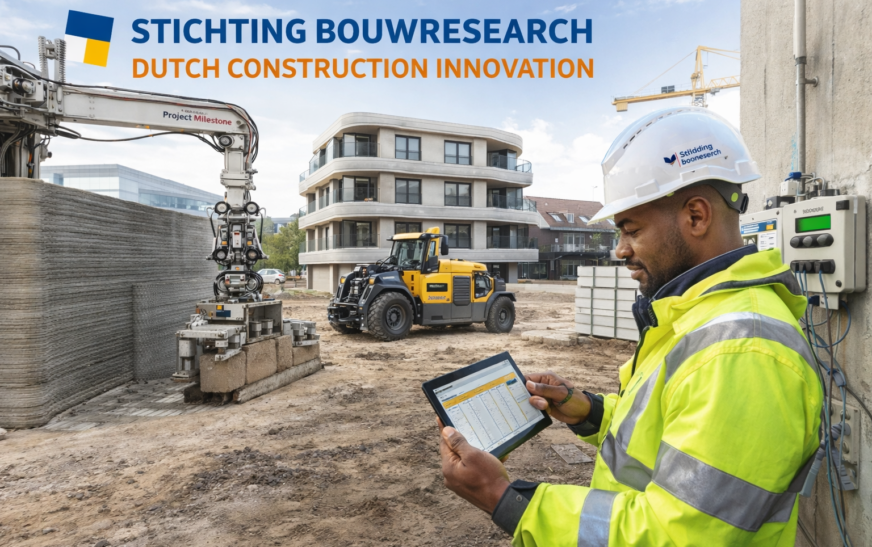
Additive manufacturing has moved from laboratory novelty to construction reality in the Netherlands. The world’s first 3D-printed concrete bridge, completed in Gemert in 2017, signaled Dutch willingness to experiment. By 2025, printed concrete structural elements were appearing in residential and commercial projects, with material formulations optimized for durability, compressive strength, and reduced Portland cement content.
SBR’s quality assurance heritage is directly applicable to this emerging field. Testing protocols for novel materials, structural performance verification methods, and warranty frameworks for non-standard construction techniques all require the kind of independent, evidence-based assessment that stichting bouwresearch has provided for traditional methods. Furthermore, the organization’s networks connect researchers developing printable material standards with the insurers and certifying bodies whose approval determines whether innovations actually reach the market.
Circular Economy and Smart Sensors
Smart sensors embedded in structural elements extend this concept further. Strain gauges, humidity sensors, and acoustic emission detectors feed continuous data streams that allow building managers to monitor structural health in real time. Consequently, maintenance becomes predictive rather than reactive, reducing waste and extending the useful life of buildings and components. SBR construction research has addressed sensor integration and data interpretation standards, helping the sector move from pilot projects to scalable practice.
Modern Case Studies and Global Relevance
The renovation of post-war social housing in cities like Rotterdam and Amsterdam offers compelling evidence of SBR principles in action. Housing corporations working with Delft-based research partners have applied SBR acoustic and thermal guidelines while simultaneously piloting digital twin monitoring and circular material tracking. These projects demonstrate that sustainable construction Netherlands is not a theoretical aspiration it is happening block by block in Dutch cities right now.
Internationally, SBR publications have been cited in building research programs across Belgium, Germany, Scandinavia, and beyond. The organization’s methodology neutral, evidence-based, practically oriented has influenced how building research institutes in other countries structure their own guidance development processes. Moreover, as the EU’s construction product regulation evolves toward stricter environmental and performance disclosure requirements, SBR’s long experience in transparent building assessment positions Dutch expertise as a valuable reference point.
Challenges, Opportunities, and Future Outlook
Dutch building innovation faces real headwinds. The construction sector grapples with acute labor shortages, rising material costs, and regulatory complexity. Integrating AI, digital twins, and circular systems into a conservative, risk-averse industry requires cultural change as much as technical development.
On the other hand, the opportunities are equally significant. The EU Green Deal and the Dutch Climate Agreement are channeling unprecedented investment into building renovation and sustainable new construction. Data infrastructure developed in the Netherlands from BIM standards to material passport platforms is being adopted at European level, multiplying its impact.
For stichting bouwresearch and its successor networks, the core challenge is remaining relevant in a rapidly evolving landscape. The organization’s greatest strength has always been trusted neutrality. In an era where AI vendors, material suppliers, and technology consultants all promote competing claims about performance and sustainability, independent quality assessment matters more than ever. Maintaining that independence, while embracing the collaborative research models that 2026 demands, will define SBR’s trajectory in the years ahead.
Conclusion
stichting bouwresearch has earned its place as a cornerstone of Dutch construction knowledge over more than six decades of rigorous, practical work. Its publications shaped regulation, its research improved buildings, and its networks connected science with practice in ways that benefited millions of people living and working in Dutch-built spaces. As AI-driven design, digital twins, 3D printing, and circular economy tools accelerate the transformation of construction, the values SBR has always embodied evidence, clarity, quality, and independence are not relics of the past. They are precisely what the sector needs to navigate an extraordinarily complex future. The built environment touches every human life. Organizations that ensure it is safe, sustainable, and honest in its claims will always have indispensable work to do.