

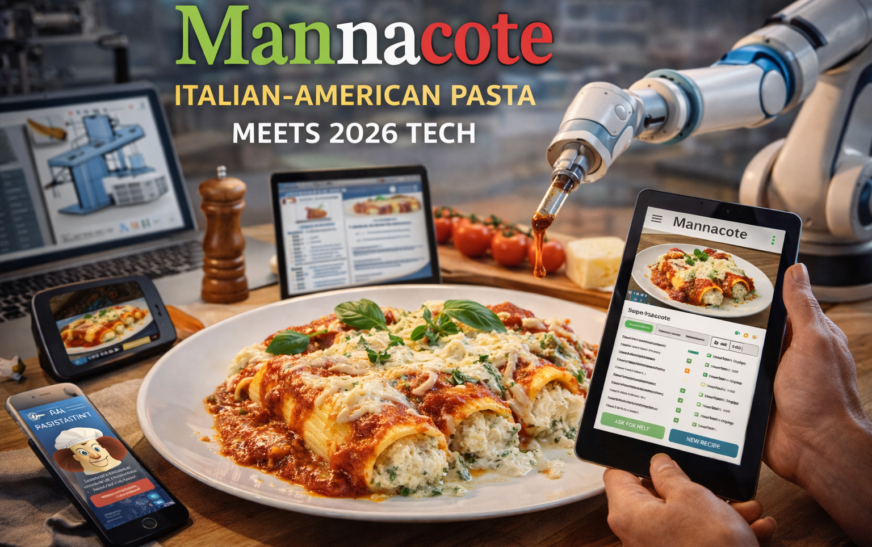
Few dishes carry as much warmth as a tray of mannacote pulled from the oven. The cheese bubbles. The sauce clings. The pasta tubes hold their filling like a gift waiting to be opened at the table. Mannacote the beloved Italian-American phonetic rendering of manicotti, heard for generations across Sunday kitchens from Brooklyn to Chicago is far more than a spelling variation. It is a cultural artifact. It carries the story of immigrant adaptation, family tradition, and communal cooking in a single baked dish. What makes this old-world comfort food newly compelling in 2026 is the wave of technology now touching every stage of its creation. AI-powered recipe tools, smart oven sensors, precision fermentation for cheese fillings, blockchain ingredient traceability, and 3D food printing are all reshaping how mannacote is made, scaled, and shared without erasing the soul that made it beloved in the first place.
Origins and Evolution of Mannacote
From Southern Italy to the American Table
Manicotti from the Italian for “little sleeves” traces its roots to southern Italian cucina povera, the humble cooking of those who made extraordinary meals from simple, affordable ingredients. Large pasta tubes filled with seasoned ricotta and baked beneath a blanket of tomato sauce required little meat and no luxury ingredients. They fed large families generously. When waves of Italian immigrants arrived in the United States between the 1880s and 1920s, they brought these recipes with them.
In American kitchens, the dish transformed. Ingredients shifted to reflect local availability. Whole-milk ricotta was sometimes blended with cream cheese or even cottage cheese. Mozzarella was layered more generously than any Italian grandmother would have recognized. The name evolved too. Spoken aloud across generations, “manicotti” became mannacote in the mouths of Italian-American communities a phonetic domestication that stuck. Cookbooks, church fundraiser pamphlets, and handwritten recipe cards preserved this spelling across the Northeast and Midwest for decades.
The Dish That Defined Celebration
Mannacote earned a specific role in Italian-American food culture. It was not an everyday meal. It appeared at Easter, Christmas Eve, first communions, and graduation parties. The effort required boiling tubes without tearing them, piping filling carefully, layering sauce with intention made it a dish reserved for occasions worth the work. That ceremonial quality has only deepened its cultural resonance. Modern Italian-American food writers and chefs have begun reclaiming mannacote as a serious subject of culinary study, tracing its regional variations and documenting the recipe differences between families, neighborhoods, and cities.
Sensory Characteristics and Flavor Profile
Texture: The Architecture of Comfort
A well-made mannacote delivers textural contrast in every bite. The pasta tube must be tender but structurally intact soft enough to yield without resistance, firm enough to hold its cylindrical shape through the baking process. The filling offers something entirely different: a yielding, cloud-like creaminess from the ricotta, interrupted by the elastic pull of melted mozzarella when the filling includes it. Surrounding everything is the sauce, which penetrates the pasta’s outer surface slightly during baking and creates a unified texture that binds tube, filling, and topping into a coherent whole.
Overcooking the pasta before filling is the most common technical failure. Even two extra minutes in boiling water can push tubes past the point of workability. Undercooking creates an unpleasantly chewy result after baking. The margin for error is narrow, which is why smart cooking technology has particular value in this dish specifically.
Taste: Layers of Gentle Complexity
The flavor of mannacote is built on restraint rather than intensity. Whole-milk ricotta contributes a mild, milky sweetness with faint lactic tang. Egg binds the filling and adds richness. Freshly grated Pecorino Romano or Parmigiano-Reggiano brings a sharp, nutty counterpoint that lifts the whole. Fresh parsley or basil introduces herbal brightness. Tomato sauce whether a simple marinara or a slow-cooked Sunday gravy adds acidity and depth that the creamy filling needs as a counterbalance.
The overall impression is one of harmonious simplicity. No single element dominates. Consequently, the quality of each individual ingredient matters more than in dishes where bold seasonings or complex technique can compensate for weaker components.
Comparisons with Related Stuffed Pasta Dishes
Mannacote sits in a family of Italian and Italian-American baked stuffed pasta dishes that includes cannelloni, lasagna rolls, and stuffed shells. Compared to cannelloni which is typically made from fresh egg pasta rolled around a filling mannacote uses a dried tube that is pre-boiled, giving it a slightly different chew and a more pronounced pasta flavor. Stuffed shells share the ricotta filling logic but differ in shape, surface area, and sauce-to-pasta ratio. Lasagna rolls offer a similar cross-section but with a flat sheet rather than a tube, producing a denser texture. Among all these relatives, mannacote occupies the middle ground: substantial but not heavy, familiar but not simplistic.
Mannacote in the Age of Smart Cooking: Recent Technologies at Play
AI-Powered Recipe Optimization
AI recipe platforms have matured significantly by 2026. Tools like those embedded in platforms such as Whisk, SideChef Pro, and proprietary smart appliance ecosystems can now analyze a user’s available ingredients, dietary requirements, and cooking history to generate optimized mannacote recipes in real time. More importantly, these systems adapt proportions dynamically. If a user’s ricotta has higher moisture content than standard a common variable that causes watery fillings the AI adjusts egg ratios and suggests a brief draining step automatically.
For professional kitchens scaling mannacote production, AI optimization tools calculate batch sizes, filling consistency targets, and sauce volumes with a precision that manual recipe scaling cannot match. Furthermore, flavor modeling algorithms trained on ingredient interaction databases can suggest substitutions for example, replacing standard ricotta with a fermented alternative and predict the sensory impact before a single test batch is made.
Smart Oven Sensors and Precision Baking
Baking mannacote involves variables that traditional ovens handle inconsistently. Surface browning, internal filling temperature, sauce reduction rate, and cheese melt timing all interact simultaneously. Smart ovens equipped with multi-zone temperature sensors and steam injection systems now available in prosumer and commercial ranges from manufacturers including June, Brava, and Rational address these variables with impressive precision.
A smart oven can monitor the surface of a mannacote tray using infrared sensors and adjust heat distribution in real time to prevent uneven browning. Steam injection during the first phase of baking keeps pasta surfaces from drying out before the filling has fully set. Internal probe connectivity where a thin sensor reads core filling temperature rather than ambient air temperature ensures the dish reaches safe and optimal serving temperature without overcooking the pasta exterior. For home cooks intimidated by the technical precision mannacote demands, this technology genuinely lowers the barrier to a successful result.
Precision Fermentation for Cheese Fillings
Precision fermentation the use of microorganisms programmed to produce specific proteins, fats, and flavor compounds has moved from laboratory concept to commercial food production between 2023 and 2026. For mannacote specifically, the most relevant application is in cheese filling production. Fermentation-derived ricotta analogues can now be produced with consistent moisture content, controlled fat ratios, and tailored flavor profiles. This addresses one of the oldest frustrations in mannacote production at scale: the variability of conventional ricotta, which differs significantly between producers, seasons, and milk sources.
In addition, precision fermentation opens possibilities for dairy-free mannacote fillings with authentic texture and flavor profiles that plant-based alternatives have historically failed to achieve. Fermentation-derived casein proteins produce melt and stretch behavior in cheese analogues that closely mimics traditional mozzarella. As a result, dietary-restriction-friendly mannacote no longer requires significant compromise.
Blockchain Traceability for Ingredients
Italian-American pasta cooking has always placed high value on ingredient quality. The provenance of San Marzano tomatoes, the origin of the ricotta, the age of the Parmigiano-Reggiano these details matter to serious cooks. Blockchain traceability systems now make this information verifiable and accessible. QR codes on ingredient packaging link to immutable records documenting farm origin, processing dates, cold chain management, and quality certifications.
For producers of premium mannacote products fresh-filled refrigerated versions sold through specialty grocers blockchain traceability provides a competitive differentiation that resonates with increasingly provenance-conscious consumers. Sustainable pasta cooking claims backed by verifiable supply chain data carry significantly more credibility than unsubstantiated marketing language.
3D Food Printing and Custom Pasta Tubes
Three-dimensional food printing has reached a level of practical application that makes it relevant to pasta production. By 2026, commercial food printing systems can extrude fresh pasta dough into tube shapes with wall thickness, diameter, and length customized to specification. For mannacote specifically, this means the chronic problem of pre-made tubes that split during boiling can be addressed through design. Printed tubes with slightly thicker walls and optimized dough hydration resist the mechanical stress of boiling and filling far better than standard dried pasta.
However, the cost and throughput limitations of food printing systems mean this technology currently serves niche applications high-end restaurant production, specialty food events, and research contexts rather than mainstream retail manufacturing. Scaling remains the key challenge, and digital twin simulations of production lines are being used to model how food printing could be integrated into larger pasta manufacturing operations cost-effectively.
Culinary Applications, Pairings, and Modern Recipes
Classic mannacote pairs naturally with a robust Sunday gravy a slow-simmered tomato sauce enriched with meat but modern preparations have expanded the pairing vocabulary considerably. A simple San Marzano marinara lets the filling speak clearly. A white béchamel-based version, inspired by northern Italian cannelloni traditions, produces a more delicate result well suited to spring menus. Fillings have diversified too: spinach and ricotta remain a beloved vegetarian option, while wild mushroom and truffle-infused ricotta appeals to contemporary fine-dining sensibilities without abandoning the dish’s fundamental logic.
As a course, mannacote functions best as a primo a first plate before a protein-centered main in the Italian tradition. In Italian-American settings, it more commonly appears as a centerpiece dish alongside meatballs, sausage, and salad. Both contexts are valid. The dish is flexible enough to occupy either role without losing coherence.
Challenges, Opportunities, and Future Outlook
The primary challenge mannacote faces is the labor intensity that defines it. Boiling, filling, and layering pasta tubes is time-consuming in a food culture increasingly pressed for time. Semi-prepared versions pre-filled tubes available fresh or frozen address this partially, but they sacrifice the customization and freshness that define the dish at its best. Smart kitchen tools help, but they cannot fully automate the care that great mannacote requires.
On the other hand, the opportunity is significant. Food nostalgia is a powerful market force. Italian-American cuisine is experiencing a genuine cultural reappraisal, driven by a generation of food writers, chefs, and home cooks interested in its history and regional specificity. Mannacote, as one of its most iconic expressions, stands to benefit from this renewed attention. Premium prepared versions with verified sustainable ingredients, smart cooking guidance built into recipe apps, and customizable fillings enabled by precision fermentation all point toward a future where this dish reaches new audiences without compromising its integrity.
Conclusion
Mannacote is not a relic. It is a living dish, one that has already survived the journey from southern Italian cucina povera to the Sunday tables of the American immigrant experience. Now it faces a different kind of journey: through the technologies of 2026 and into kitchens that look very different from the ones that first gave it its name. AI recipe optimisation, smart ovens, precision fermentation, blockchain traceability, and 3D food printing each offer genuine improvements to how this dish is made, scaled, and sustained. None of them replaces the human judgment, cultural memory, and simple pleasure that have always defined a great tray of stuffed pasta. For home cooks and the pasta industry alike, the path forward is the same one that Italian-American cooking has always walked: honouring the past clearly enough to move beyond it wisely.