
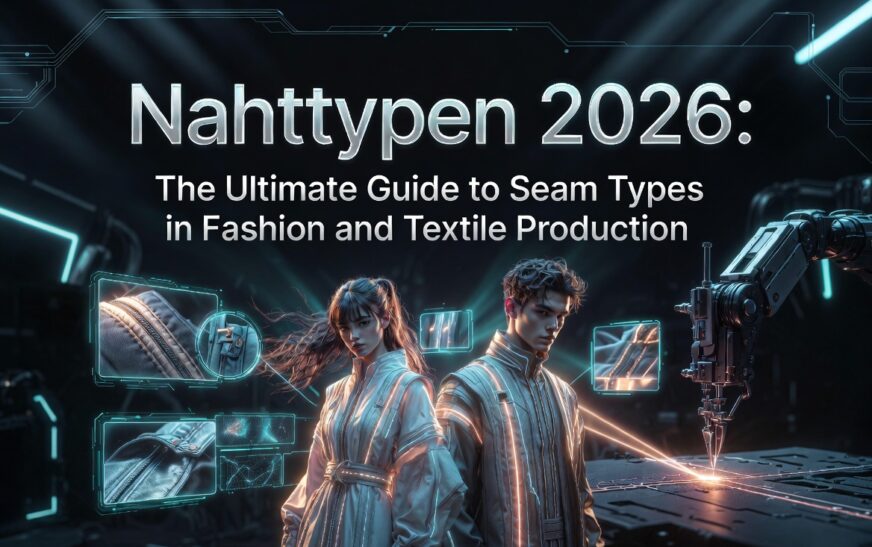
Every garment you wear tells a story stitched together one seam at a time. Nahttypen or seam types, are the structural backbone of all clothing, from everyday basics to high-end fashion. Choosing the wrong seam can compromise durability, aesthetics, and comfort, while selecting the right one elevates the entire garment. In 2026, this once-traditional craft has been radically transformed. Artificial intelligence, robotic sewing arms, ultrasonic welding, and laser seaming have redefined what’s possible on the factory floor and in the atelier. Whether you’re a seasoned garment manufacturer, a fashion designer exploring new techniques, or a home tailor expanding your skillset, understanding the full spectrum of Nahttypen is more valuable than ever. This guide walks you through every essential seam type, compares traditional and modern approaches, and reveals how cutting-edge technologies are shaping the future of seam construction well into the next decade.
What Are Nahttypen ? Definition and Importance
At their most fundamental level, Nahttypen describe the various methods used to join two or more pieces of fabric together. A seam is not merely a functional connection it simultaneously defines a garment’s silhouette, influences how it moves on the body, and determines its longevity through repeated wear and washing.
In professional garment construction, the choice of seam type affects:
- Structural integrity is how well the garment withstands tension and stress
- Aesthetic finish, whether the inner construction is visible, concealed, or decoratively exposed
- Fabric compatibility: Certain seams suit stretch fabrics, while others are designed for woven textiles
- Production efficiency, some seams require multiple passes and pressing steps, while others are completed in a single operation.
For example, a premium denim manufacturer uses flat-felled seams on jeans to deliver both strength and a clean, visible stitch line that defines the brand aesthetic. Conversely, a lingerie producer relies on narrow French seams to prevent raw-edge irritation against sensitive skin. Understanding these distinctions is the foundation of quality garment production.
The 10 Most Common Nahttypen Explained
You will discover that each seam type serves a distinct purpose. Here are the ten most widely used Nahttypen in modern garment construction:
- Plain Seam (Einfache Naht) The most basic seam, sewn with right sides together and pressed open. Ideal for woven fabrics and structural seams in tailoring.
- French Seam (Französische Naht) A seam sewn twice to fully encase raw edges. Perfect for delicate fabrics like silk and chiffon.
- Flat-Felled Seam (Flachnaht) Both allowances are folded and topstitched flat. Used in denim and workwear for maximum durability.
- Overlocked Seam (Overlock-Naht) Raw edges are simultaneously trimmed and finished using a serger. The standard in ready-to-wear production.
- Bound Seam (Eingefasste Naht) Seam allowances are wrapped in binding tape. Common in unlined jackets and high-end tailoring interiors.
- Lapped Seam (Überlappungsnaht) One fabric edge overlaps another and is topstitched. Frequently used in leather goods and thick outerwear.
- Welt Seam (Wulstnaht) A single seam allowance is pressed to one side and topstitched, creating a visible ridge. Popular in sportswear and casualwear.
- Mock French Seam: A simplified version of the French seam folded inward and stitched. Widely used when speed and a neat interior finish are both priorities.
- Hairline Seam: An extremely narrow seam for sheer or very fine fabrics where bulk must be eliminated.
- Safety Stitch Seam: A combination of chain stitch and overlock used in high-stress seams on activewear and children’s clothing.
Each of these Nahttypen carries specific trade-offs between production time, fabric suitability, and visual result.
Traditional vs. Modern Seam Techniques
For centuries, seam construction depended entirely on the skill of the individual tailor. Traditional Nahttypen were sewn by hand or on basic mechanical sewing machines, with trained eyes and experienced hands ensuring consistency. This approach produced extraordinary results in couture; however, it was inherently slow, labor-intensive, and difficult to scale.
Industrial manufacturing introduced the lockstitch machine in the 19th century, dramatically increasing output. By the late 20th century, computerized sewing machines allowed programmable stitch patterns and consistent tension control. Nevertheless, human operators still guided fabric through each seam manually, introducing natural variability.
Modern techniques represent a fundamental shift. Today, automated cutting tables pre-position fabric panels with micron-level accuracy, feeding them directly into semi-autonomous sewing stations. As a result, seam consistency has improved dramatically, reducing defect rates in large factories by up to 40% compared to fully manual production lines.
How Recent Technologies Are Revolutionizing Nahttypen in 2026
The technological transformation of seam construction is arguably the most significant development in garment manufacturing in the past century. You will find that several innovations are reshaping Nahttypen across every segment of the industry.
AI-Powered Sewing Machines and Computer Vision
Modern AI-equipped sewing machines use computer vision systems to detect fabric edges, seam allowances, and pattern alignment in real time. These systems self-correct during the sewing operation, ensuring perfectly parallel seam lines even on curved panels a task that previously required years of skill to master.
Robotic Sewing Arms
Robotic sewing arms, such as those developed by SoftWear Automation and similar companies, handle limp fabric using advanced gripping technology and machine learning. These systems can assemble basic garment seams at speeds exceeding 1,000 stitches per minute while maintaining consistent quality across entire production runs.
Ultrasonic Welding and Laser Seaming
Perhaps the most disruptive advancement in Nahttypen technology is the elimination of thread altogether. Ultrasonic seams bond synthetic fabrics using high-frequency sound vibrations, creating waterproof, seamless joins ideal for activewear, outerwear, and medical textiles. Similarly, laser seaming uses concentrated light energy to fuse fabric edges, producing extraordinarily precise, clean bonds with no needle holes a major advantage for technical performance wear.
3D-Printed Seams and Smart Fabrics
Additive manufacturing has introduced 3D-printed seam structures directly onto garment panels, enabling geometric precision impossible with conventional stitching. Furthermore, smart fabrics embedded with conductive threads and sensors require specialized seam types that preserve electrical conductivity while maintaining flexibility and washability an emerging standard in wearable technology.
Sustainable and Waterless Seam Technologies
In response to growing environmental pressure, manufacturers are adopting eco-friendly bonding adhesives and waterless seam finishing processes. These techniques significantly reduce chemical waste and water consumption during garment assembly, directly supporting Industry 4.0 circular economy goals.
Choosing the Right Nahttyp for Different Fabrics and Garments
Selecting the correct Nahttyp begins with understanding your fabric’s behavior. Woven fabrics tolerate plain and bound seams well, while knit fabrics demand stretch-capable seams like the overlock or safety stitch. Sheer fabrics benefit from French or hairline seams that eliminate visible bulk and raw edges.
Garment function equally drives seam selection. High-performance sportswear demands flat or ultrasonic seams that minimize chafing against the skin. Outerwear requires waterproof laser or welded seams, while structured tailoring relies on hand-finished or bound seams for both strength and an elevated interior appearance.
A practical guideline for designers and manufacturers:
- Stretch fabrics: Overlock, safety stitch, or flatlock seams
- Sheer or delicate fabrics: French, hairline, or mock French seams
- Denim and canvas: Flat-felled or lapped seams
- Technical and performance wear: Ultrasonic, laser, or bonded seams
- Couture and tailoring: Bound, hand-finished plain seams
Benefits of Advanced Nahttypen Technologies for Brands and Manufacturers
Adopting modern Nahttypen technologies delivers measurable advantages across the entire production chain. Quality consistency improves dramatically because automated systems remove human error from seam construction. Additionally, production speed accelerates robotic sewing stations can operate continuously without fatigue-related quality drops.
Cost efficiency improves over time as waste reduction, fewer defects, and faster throughput offset initial capital investment. Moreover, sustainable seam technologies help brands meet increasingly strict environmental regulations and satisfy consumer demand for responsible manufacturing practices. Several leading sportswear brands have already reported a 30% reduction in material waste after transitioning to laser and ultrasonic seaming across core product lines.
Challenges and Future Trends in Seam Technology (2026–2030)
Despite remarkable progress, significant challenges remain. High upfront costs for robotic and AI-integrated systems place advanced Nahttypen technology out of reach for smaller manufacturers and independent designers. Additionally, training workforces to operate and maintain these systems requires substantial investment in time and education.
Looking ahead to 2030, several trends are expected to define the next phase of seam technology development:
- Fully autonomous garment assembly lines capable of handling complex multi-seam garments without human intervention
- Bio-based bonding agents derived from natural polymers replacing synthetic adhesives in bonded seams
- Real-time seam quality monitoring using embedded IoT sensors that flag defects during production rather than after
- Customization at scale enabled by AI pattern recognition, allowing mass-produced garments to incorporate individually tailored seam placements
Conclusion
Nahttypen are far more than functional necessities they are the engineering decisions that define a garment’s quality, performance, and lifespan. From the timeless French seam to the cutting-edge ultrasonic weld, every seam type carries distinct advantages suited to specific fabrics, end uses, and production environments. As a designer, manufacturer, or tailor, investing time in understanding these differences pays dividends in every garment you create. Modern seam technologies offer unprecedented consistency, sustainability, and precision that were unimaginable even a decade ago. However, foundational knowledge of traditional Nahttypen remains irreplaceable it provides the judgment to select and apply new technologies intelligently. The seams of tomorrow will be smarter, cleaner, and more sustainable than ever before, and those who master both the craft and the technology will lead the next era of fashion and garment manufacturing.